OPC vs gravimetric PM measurement: the key difference
Optical Particle Counters and gravimetric samplers can both report PM2.5 and PM10 in µg/m³, but they reach that result in fundamentally different ways.
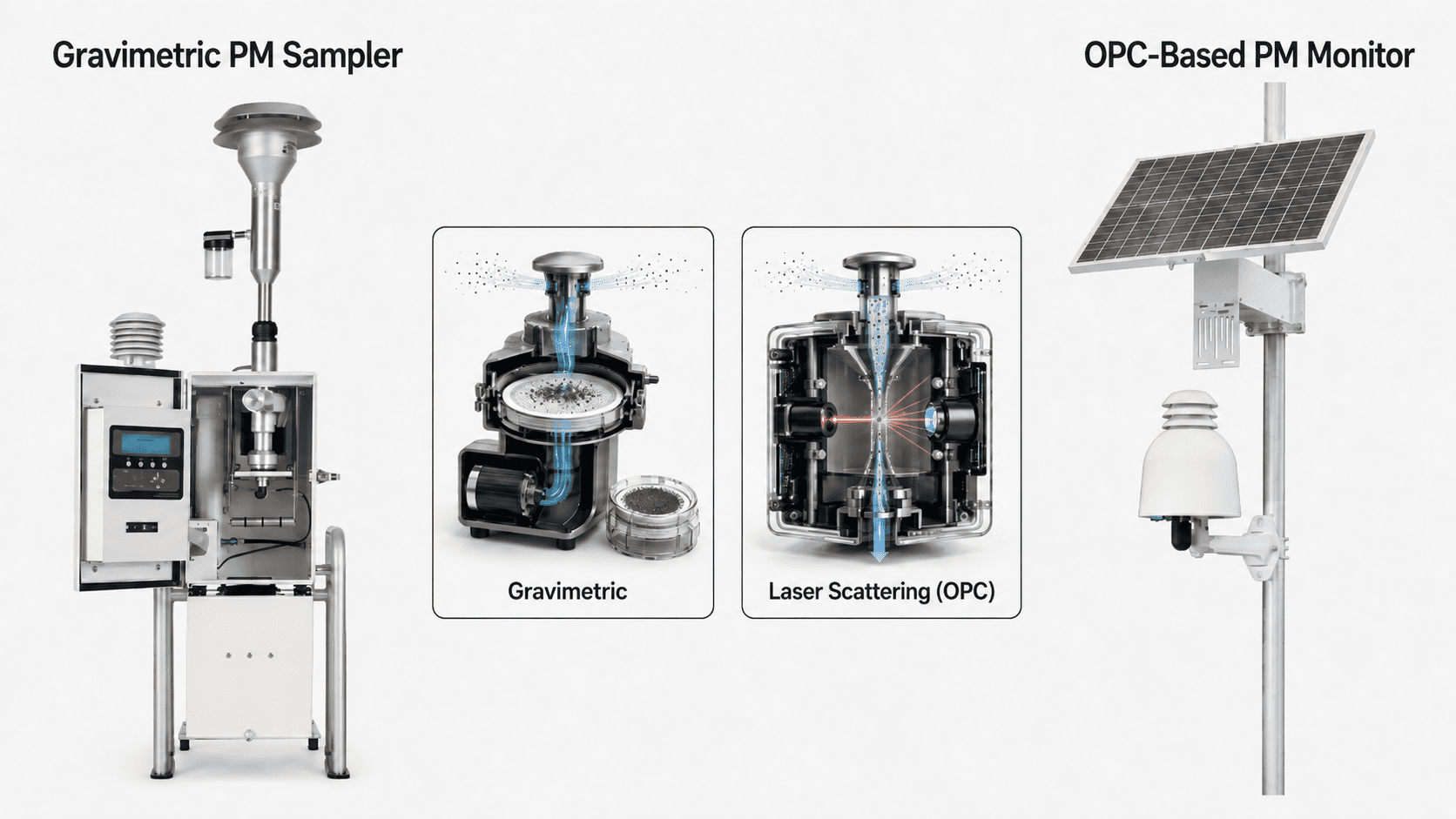
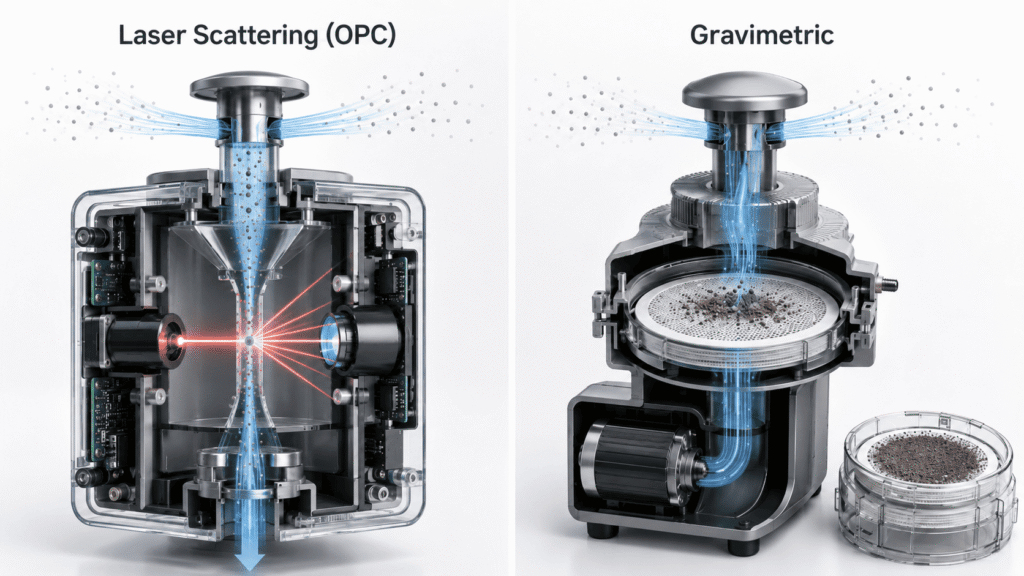
A gravimetric method collects particles on a filter and determines the collected mass by weighing the filter before and after sampling. An Optical Particle Counter, or OPC, detects particles from the light they scatter, estimates their optical size, counts them and converts that information into an estimated particulate mass concentration.
The practical difference is simple: gravimetric methods determine collected particle mass, while OPCs derive an estimated PM mass concentration from optical particle measurements. A standardized gravimetric reference method is the appropriate choice when reference-method mass determination is required. OPC technology becomes especially valuable when a project needs continuous data, multiple monitoring points and cost-effective spatial coverage.
The right question is therefore not which method is universally better, but which method provides the information needed for the decision at hand.
How gravimetric particulate matter measurement works
In gravimetric sampling, a controlled volume of ambient air passes through a size-selective inlet designed for a particulate fraction such as PM10 or PM2.5. Particles are collected on a filter over a defined sampling period. The filter is conditioned and weighed before and after exposure, and the mass difference is divided by the sampled air volume.
PM concentration = collected particle mass / sampled air volume
For ambient air monitoring in the European Union, EN 12341:2023 is the reference gravimetric method for PM10 and PM2.5 under Directive (EU) 2024/2881.
The method provides a standardized determination of particulate mass, but it is inherently an integrated measurement. A short dust event, a traffic peak and several hours of low concentrations may all contribute to the same sampling-period result. Filter handling, conditioning, weighing and controlled airflow also make the method relatively resource-intensive when many monitoring locations are required.
How an Optical Particle Counter measures PM2.5 and PM10
An OPC uses an optical measurement chamber containing a light source and a photodetector. As particles pass through the illuminated measurement volume, they scatter light. The optical signal is used to estimate particle size and assign particles to different size ranges, or bins.
For air quality monitoring, the resulting particle number-size distribution is converted into an estimated mass concentration. In simplified form:
light scattering → optical particle size → particle counts → estimated particle volume → estimated mass → PM concentration
Because the measurement is electronic and continuous, OPC-based systems can report changing particulate levels at intervals of seconds or minutes rather than integrating the entire period into a single filter result.
When is an OPC the right choice?
OPC technology is most valuable when the monitoring objective depends on time resolution, spatial coverage and operational visibility, rather than on a reference gravimetric result alone.
When you need to see events, not only averages
Continuous optical measurements can show when PM concentrations rise, how quickly they change and how long an event lasts. This matters in applications such as construction dust, industrial activities, road resuspension and other situations where short-duration peaks can disappear inside a daily average.
When you need cost-effective coverage across more monitoring points
Many air quality questions are spatial. A single measurement point may not describe what is happening at a site boundary, across a construction area or along an urban corridor. Compact OPC-based monitors make multi-point networks practical, allowing operators to compare locations and identify local patterns that a sparse network can miss.
The economic advantage of OPC monitoring is strongest at network level. Compared with reference gravimetric sampling, compact sensor-based stations generally require less infrastructure and less manual effort per measurement point. This can make it economically practical to install several monitoring locations within the same project.
For project owners, the relevant comparison is not simply instrument purchase price. It is the total cost of ownership of the monitoring network: hardware, installation, power, communications, consumables, servicing, staff time and the number of locations required to answer the monitoring question.
An OPC network can therefore be the more cost-effective choice when value comes from continuous coverage across several points. The trade-off is that optical PM data require a clear understanding of sensor performance and environmental influences.
When data must support operational action
High-frequency measurements can feed dashboards, alerts and reporting workflows. This is useful when environmental teams need to investigate an event while it is happening, review PM conditions before and after an operational change or trigger a predefined response when particulate levels increase.
When multiple PM fractions add useful context
Many OPCs can report several particulate fractions from the same sensing system, such as PM1, PM2.5 and PM10. The relationship between fine and coarse fractions can provide additional context when interpreting the likely character of a particulate event, although it should not be treated as source identification on its own.
Typical applications where these advantages are valuable include construction and demolition monitoring, industrial perimeter monitoring, urban and traffic networks, research deployments, hotspot investigation and distributed environmental monitoring.
When is gravimetric measurement the right choice?
A standardized gravimetric reference method remains the appropriate choice when the objective is reference-method mass determination or when the applicable regulatory framework requires it.
It is also useful when an integrated mass value over a defined sampling period is the main information required, or when collected filter material is needed for subsequent laboratory analysis.
Why OPC and gravimetric PM results can differ
Differences between the two methods are expected because they respond to different physical properties of the aerosol. A difference does not automatically indicate that either instrument is malfunctioning.
Optical diameter is not aerodynamic diameter
PM10 and PM2.5 reference fractions are defined through aerodynamic behaviour and standardized size-selective sampling. An OPC estimates an optical equivalent size from scattered light. Particle shape and density therefore influence the relationship between optical and aerodynamic sizing.
Particle density and composition affect mass estimation
An OPC does not weigh each particle. Converting particle size and count into mass requires assumptions or calibration relationships. Mineral dust, sea salt, combustion aerosol and secondary atmospheric particles can have different densities and optical properties, so the same conversion model will not represent every aerosol equally.
Relative humidity can influence optical response
Many atmospheric particles absorb water as relative humidity increases. Particle growth changes light scattering and can increase the apparent particulate concentration reported by an optical instrument. At very high humidity, suspended water droplets may also interfere with particle detection.
Coarse particulate matter can be more demanding
PM10 measurement can be more challenging than PM2.5 for compact optical instruments. Larger particles contribute strongly to mass but can be harder to transport efficiently through small sampling paths. Inlet geometry, airflow design and the detectable particle-size range are therefore particularly important for construction dust, mineral dust and other coarse-aerosol applications.
OPC operating life is model-dependent
Operating life is another practical limitation that should not be generalized across OPC technology. Different designs use different optical sources, fans or pumps, airflow management and contamination-control strategies.
Some OPC models are designed for multi-year field operation, while others have a more limited expected service life. Particle loading, environmental exposure, duty cycle and maintenance conditions can also affect longevity. Sensor lifetime should therefore be evaluated at model level and included in the total cost of ownership assessment.
OPC vs gravimetric PM measurement at a glance
| Characteristic | Gravimetric method | Optical Particle Counter |
|---|---|---|
| Primary principle | Particle collection and filter weighing | Optical detection and particle counting |
| PM mass | Determined from collected mass | Estimated from optical size and count data |
| Typical time resolution | Integrated sampling period | Seconds to minutes |
| Short-duration events | Limited temporal visibility | High temporal visibility |
| Spatial network deployment | More resource-intensive | Well suited to multi-point networks |
| Cost profile | Higher infrastructure and manual workload per point | Typically lower cost and workload per monitoring point |
| Particle-size information | Not provided by mass result alone | Available across instrument size bins |
| Key influences | Sampling, conditioning, handling, flow control | Aerosol properties, humidity, sampling design, algorithms |
| Operating life | Sampler plus filter/consumable workflow | Strongly dependent on OPC model and field conditions |
| Typical role | Standardized reference-method mass determination, where applicable | Continuous supplementary and operational monitoring |
What should you look for in an OPC-based PM monitor?
The term Optical Particle Counter describes a measurement principle, not a single performance class. Two OPC-based monitors can differ substantially even when both report PM2.5 and PM10.
A project specification should therefore consider the factors that materially affect field performance and ownership:
- particle-size detection range and the PM fractions required;
- airflow stability, inlet design and sampling-path geometry;
- performance with fine or coarse aerosol, depending on the application;
- temperature and humidity operating conditions;
- data-processing and environmental compensation approach;
- expected operating life and replacement strategy;
- cleaning, servicing and other maintenance requirements;
- data frequency, connectivity and integration with the wider monitoring workflow.
This is particularly important for outdoor projects. An OPC that performs well for indoor fine-particle monitoring is not automatically the best choice for a construction site dominated by coarse mineral dust, and a sensor selected for a short campaign may not be the best option for a multi-year network.
How Aernode uses OPC technology
Aernode uses Optical Particle Counter technology for continuous particulate matter monitoring and can support different OPC configurations according to project requirements.
This flexibility matters because OPCs are not interchangeable. Sensor designs can differ in particle measurement capability, environmental operating range, expected service life and maintenance profile. Selecting the appropriate configuration allows the particulate sensing layer to be aligned with the monitoring objective rather than forcing every project onto a single PM sensor.
Within the Aernode ecosystem, particulate monitoring is combined with environmental parameters, connectivity, data management and reporting tools. This makes OPC technology especially useful where continuous supplementary monitoring supports network supervision, event investigation, operational alerts or multi-point environmental monitoring.
Explore the Aernode Air Quality Monitor and Aernode Sensor Kits for the current system architecture and sensing options.
Which method should you choose?
Choose a standardized gravimetric reference method when the project requires reference-method mass determination or when that method is specified by the applicable regulatory framework.
Choose OPC monitoring when the project needs continuous measurements, short-event visibility, several monitoring locations or a cost-effective way to increase spatial coverage.
For most operational monitoring projects, the strongest reason to use an OPC is not simply that it is smaller or less expensive. It is that it can generate a different type of information: frequent measurements from enough locations to understand when and where particulate conditions change.
Technical references
- Directive (EU) 2024/2881 of the European Parliament and of the Council – reference method for PM10 and PM2.5 measurement (EN 12341:2023).
- U.S. Environmental Protection Agency – Enhanced Air Sensor Guidebook (2022).
- U.S. Environmental Protection Agency – Air Sensor Performance Targets and Testing Protocols for non-regulatory supplemental and informational monitoring.
- European Commission Joint Research Centre – Guidance on air quality sensor deployment for non-experts and researchers.
- World Meteorological Organization, GAW Report No. 293 – Integrating Low-Cost Sensor Systems and Networks to Enhance Air Quality Applications (2024).