Construction site dust monitoring starts with the monitoring objective
A practical construction site dust monitoring plan is not simply a list of instruments and fixed locations. It is a decision framework that links a monitoring question to the particulate metric, measurement method, monitor locations, weather context, alert response and data-quality controls. Because demolition, earthworks, haul routes, stockpiles and material handling move across a project, a layout that works in one phase can become poorly aligned with the next.
The operational stakes are straightforward: a monitor can be functioning correctly yet still answer the wrong question if it is sheltered, too far from the relevant boundary, dominated by an unrelated local source or left behind as the workface moves. An alert is also of limited value if nobody has defined what to check, who is responsible or what action follows. The monitoring plan therefore needs to move with the project, not just collect data beside it.
This Guide focuses on continuous ambient and perimeter particulate monitoring for construction and demolition projects. It does not cover personal occupational exposure or respirable crystalline silica exposure measurement, which require workplace-exposure methods appropriate to the worker and substance. It also does not treat deposited nuisance dust as interchangeable with PM10 or PM2.5: dustfall and soiling can require different monitoring methods when those are the actual project concerns.
Start with the objective, not the instrument. The IAQM construction-monitoring guidance, developed for UK practice, says the purpose of monitoring should be considered before the strategy is finalised because the objective drives the method, number and location of monitoring points, baseline need and whether locations remain fixed or move with the works. The underlying planning principle is broadly transferable: define the decision first, then design the measurement system around it.
- detect short-duration particulate events while dust-generating work is underway;
- check whether dust-control measures are reducing measured particulate levels;
- review conditions at site boundaries or toward sensitive receptors;
- support investigation of complaints or reported off-site events;
- provide a continuous supplementary data layer within a Dust Management Plan (DMP), Construction Environmental Management Plan (CEMP) or equivalent site procedure;
- meet a permit, planning condition, contract or authority requirement where the monitoring method, location, averaging period and reporting rules are explicitly specified.
These objectives are not identical. A near-real-time monitor used as an operational trigger for site investigation answers a different question from a method selected for formal comparison with an ambient-air limit value. Define the role of the data before choosing the monitoring technology, and let any applicable permit, planning condition or formal assessment requirement override a generic monitoring-plan template.
Choose the particulate metric before choosing the monitor
“Dust” is broader than one particulate metric. Construction activities can release coarse material that deposits close to the source, suspended particles within the PM10 fraction, finer particles within PM2.5 and combustion-related particles from engines and generators. A monitoring plan should therefore state exactly what is being measured and why.
PM10: usually the core airborne-dust metric
For many construction and demolition projects, PM10 is the most useful primary airborne particulate metric because mechanically generated dust from demolition, earthworks, cutting, stockpiles, unpaved surfaces and vehicle movements can contribute strongly to the coarse fraction. IAQM professional guidance developed for UK construction practice recommends prioritising PM10 for this reason. That recommendation is useful as technical practice, but it is not itself an EU-wide legal requirement.
PM2.5: useful when the objective includes finer particles
PM2.5 can add context where the project needs to understand the fine fraction, where combustion sources are relevant, or where a project specification requires both PM10 and PM2.5. It should not be treated as a second name for the same signal: a coarse mineral-dust event can produce a different PM10-to-PM2.5 pattern from a fine-particle or combustion-influenced episode.
TSP, dustfall and soiling: different questions
Total suspended particulate (TSP), dust deposition and surface soiling relate to dust but answer different questions. TSP covers a wider airborne particle-size range than PM10, while dustfall and soiling methods are designed around material that deposits onto surfaces. If visible deposition or nuisance is a central project concern, the monitoring plan may need a complementary dust-deposition or soiling method rather than trying to answer that question with PM data alone.
Continuous optical PM and formal reference measurement have different roles
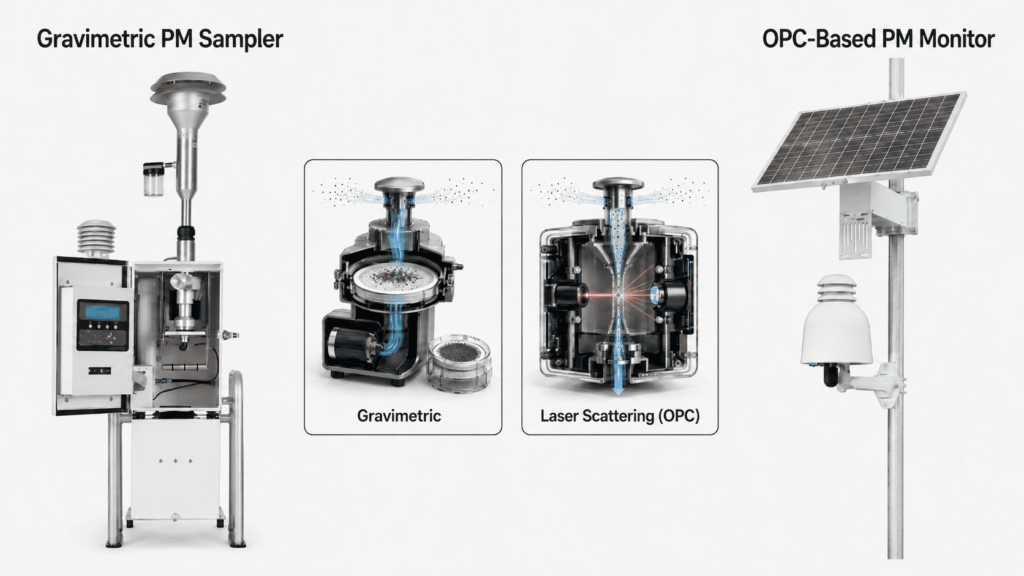
For formal ambient-air assessment in the European Union, the applicable reference method matters. Directive (EU) 2024/2881 sets out EN 12341:2023 as the reference gravimetric method for PM10 and PM2.5 under the recast EU framework. The Directive also sets requirements for formal ambient-air sampling and roles for indicative measurements. A continuous sensor network is therefore not reference-equivalent simply because it reports PM in micrograms per cubic metre.
For operational construction monitoring, continuous optical instruments can add high-time-resolution and spatial information for trend review, alerts and event investigation. Where the project needs statutory comparison or formally reportable ambient-air data, use the method, siting, quality system and averaging rules required by the applicable European, national or project-specific framework. For a deeper method comparison, see the Aernode Guide OPC vs Gravimetric Particulate Matter Measurement.
Map sources, boundaries and receptors before placing monitoring nodes
Monitor placement should follow the objective and the source-boundary-receptor geometry. Even spacing around a fence can look systematic while missing the locations that matter. The same instrument may be placed differently depending on whether the priority is operational dust control, receptor-facing context, event investigation or formal comparison with an ambient-air objective.
| MONITORING OBJECTIVE | LOCATION EMPHASIS | PRIMARY USE OF THE DATA |
|---|---|---|
| Operational dust control | Boundary or source-relevant points near the current dust-generating activity, plus contextual coverage where feasible | Early warning, investigation and review of mitigation effectiveness |
| Receptor-facing environmental oversight | Boundary or representative locations toward exposed receptors, with enough spatial context to interpret other local sources | Review whether short-term changes are consistent with transport toward off-site locations |
| Complaint / event investigation | Multiple locations where possible, paired with meteorology and activity logs | Compare timing and spatial pattern; support an evidence-based investigation without claiming automatic source attribution |
| Formal objective / permit comparison | Authority-defined or representative receptor location using the specified method and QA requirements | Formal assessment under the applicable regulatory or project framework |
Practical siting matters as much as the map. Inlets should be in a clear, representative microenvironment rather than boxed behind hoarding, immediately beside a wall or directly in the exhaust of an unrelated source. Access, power, connectivity and security matter, but they should not quietly override the monitoring objective.
Formal EU micro-siting rules are a separate layer from the broader questions of air-quality network siting and density. For sampling points used in formal ambient-air assessment, Directive (EU) 2024/2881 includes requirements on unobstructed airflow, inlet height, avoidance of immediate unmixed sources, site documentation and periodic review. Those criteria should be followed when they apply; they are not a universal template for an operational construction fenceline network whose purpose is different.
How many monitors are needed?
There is no universal node count that fits every project. A single monitor can answer a tightly defined local question, but it provides little spatial information on a large or changing site. At least two distinct monitoring roles – for example, a receptor-facing or source-relevant point plus a contextual/background point – often make interpretation more useful. Additional points become valuable when the project needs to cover several receptor directions, compare opposite boundaries, follow multiple active work areas or maintain coverage under variable winds.
Network density should be proportionate to site size, source variability, receptor geometry, wind variability, data purpose and the confidence required from the programme. Background, upwind and downwind are roles rather than permanent identities: as wind direction changes, a node that was upwind can become downwind. Use meteorology and the full spatial pattern to interpret those changes rather than assigning a fixed source label to one monitor.
Build the monitoring plan around changing construction phases
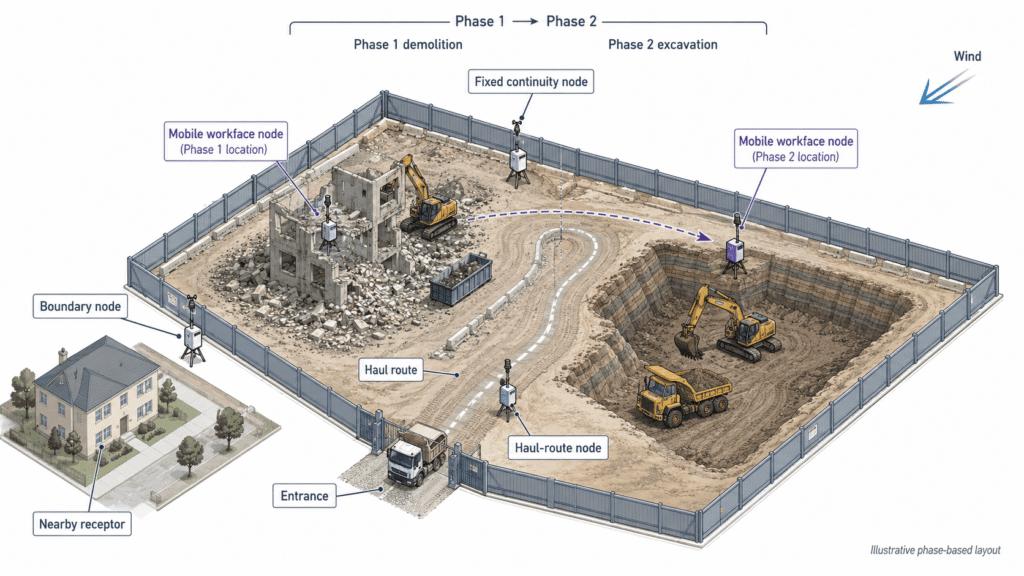
The dust source map at a construction site is temporary. A demolition workface may dominate for several weeks, then the main source can shift to excavation, haul roads, stockpiles or material handling. Monitoring points that were well placed in one phase can become poorly located in the next. The plan should therefore include formal review points linked to the programme of works.
Review the layout when the phase changes. IAQM construction-monitoring guidance, developed for UK practice, explicitly notes that monitoring strategies may change between phases and that sampling locations can remain fixed or be relocated as works progress. It also warns that unchanged locations can become too distant from dust-raising activities or newly exposed receptors. The underlying planning lesson is broadly transferable: treat project phase as a monitoring variable.
| PROJECT PHASE / ACTIVITY | TYPICAL MONITORING CONCERN | PRACTICAL PLANNING IMPLICATION |
|---|---|---|
| Pre-start / baseline where required | Existing background particulate patterns and other local sources | Use the same metric and a comparable method/location strategy where baseline data are needed; justify duration from the objective and seasonal context. |
| Demolition and breaking | Short, intense and spatially variable coarse-dust events | Prioritise receptor-facing and source-relevant locations; make alert response and field checks easy to execute. |
| Earthworks, excavation and stockpiles | Moving workfaces, exposed dry surfaces and wind-driven resuspension | Review node locations as excavation fronts and stockpiles move; retain enough spatial coverage to interpret changing relationships. |
| Haul roads, entrances and logistics | Vehicle-generated resuspension, trackout and recurring traffic patterns | Include access points or road-facing boundaries when they are material to the dust question; use activity logs to interpret recurring peaks. |
| Later construction / fit-out | More localised cutting, handling and intermittent activities | Recheck whether the original network is still proportionate; remove, relocate or add points only when the monitoring objective changes. |
Worked example: keep continuity while following the workface
Consider a site that begins with demolition beside its western boundary and later moves into excavation on the eastern half. During demolition, a receptor-facing western boundary monitor may be the most important operational point, supported by a second node providing background or opposite-boundary context and a third covering the main haul route.
When demolition ends and excavation moves east, leaving every monitor in place may preserve continuity but weaken relevance. A stronger plan may keep one fixed node for continuity, relocate the workface-related node toward the eastern boundary and retain the haul-route node if vehicle resuspension remains material. The exact arrangement depends on the site; the planning principle is to preserve enough continuity to interpret trends while moving enough coverage to keep answering the current question.
Decide whether baseline monitoring adds useful context
Baseline data can help distinguish existing particulate patterns from changes that appear after work begins, and can inform project-specific alert interpretation. It is most useful when the baseline uses the same metric, comparable instrumentation and locations that remain meaningful during the works. A short baseline from a different season or weather regime can be less representative than it appears, so duration should be justified from the monitoring objective and programme rather than treated as a universal rule.
UK IAQM professional guidance notes both that baseline monitoring can be useful where site-specific action levels or sensitive comparisons are needed and that it is not necessary in every situation. For a European project, any planning condition, permit or authority-agreed monitoring plan takes precedence. Where a dedicated baseline is not required, nearby monitoring data, meteorology, site observations and activity records can still provide context if their representativeness and limitations are understood.
Use meteorology to interpret PM events
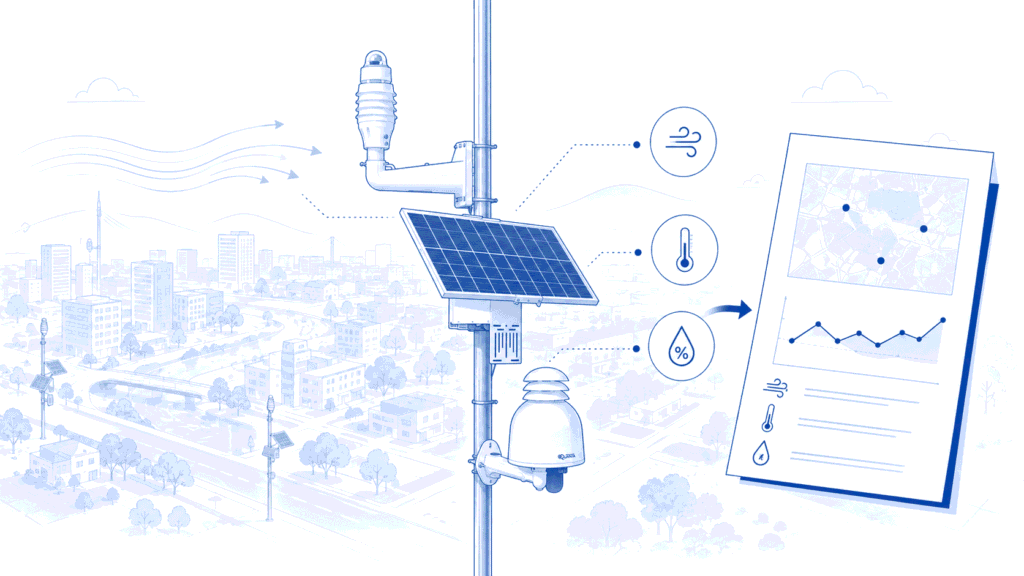
Wind speed and direction are among the most useful elements of meteorological context for a construction dust network. When a PM peak occurs, wind direction can show whether transport from an active work area toward a boundary or receptor is physically consistent with the event. Wind data can also explain why one boundary monitor responds while another does not. This supports investigation; it does not prove source attribution on its own.
Rainfall and humidity can also change both site conditions and the behaviour of some optical monitoring systems. If those variables are material to the selected method, record them and understand the instrument performance envelope. Meteorological sensors need representative exposure too: a wind sensor immediately behind a hoarding panel or tall obstruction may describe a local wake rather than the airflow affecting the wider site.
Turn real-time PM data into an operational alert workflow
Real-time data becomes most useful when it is connected to an operational alert workflow with a predefined response. The threshold, averaging period, persistence rule and escalation path should be set for the specific project and monitoring method, using any applicable planning condition, permit, DMP/CEMP, authority guidance and baseline context. A generic number copied from another project can be inappropriate because monitoring methods, background concentrations and regulatory frameworks differ.
Do not transplant a construction action level without its context. IAQM guidance for UK construction practice includes a generic one-hour PM10 site action level of 190 micrograms per cubic metre, but IAQM’s 2025 Position Statement warns that low-cost sensor systems used for this purpose must be demonstrated fit for the relevant elevated concentrations and that site-specific action levels need to reflect sensor capability. This is a useful UK professional-practice example, not an EU-wide threshold. On a European project, the agreed project, national and authority requirements determine the applicable trigger logic.
An alert should start an investigation, not automatically declare a breach or identify the source. A practical workflow is:
- Confirm that the reading is technically plausible and that the monitor is operating normally.
- Check wind direction, wind speed, rainfall and humidity where available.
- Compare nearby nodes or background/upwind information to understand the spatial pattern.
- Check the activity log: demolition, excavation, cutting, haul-road traffic, deliveries, stockpile handling or other relevant work.
- Inspect the site to confirm the work activity, local conditions and any visible control issue relevant to the event.
- Apply the predefined mitigation or operational response where warranted, such as adjusting water suppression, road cleaning, covering, traffic management or temporarily modifying a dust-generating task.
- Review the subsequent measurements and record the event, action and outcome.
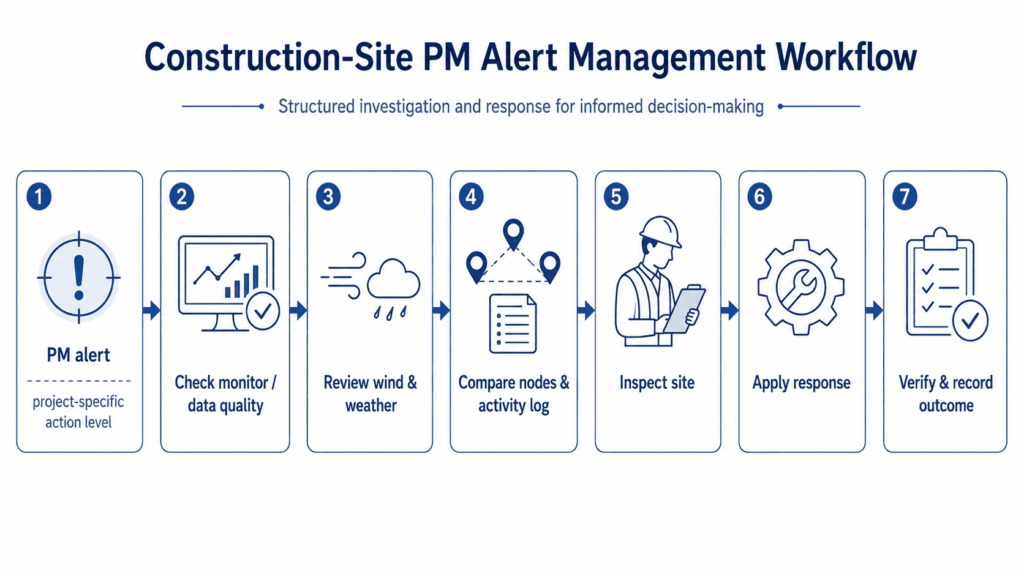
This sequence turns the monitoring system into part of the environmental-management process rather than a passive dashboard. It also creates a traceable record of what the team observed, checked and did. The final verification step matters: monitoring is strongest when the team examines what happened after an intervention instead of assuming that the action worked.
Put QA/QC and instrument fitness inside the monitoring plan
A high-frequency data stream is not automatically a high-quality dataset. The monitoring plan should define how instruments are selected, installed, checked, serviced and reviewed, and how questionable periods are handled before reporting. This is especially important for optical particulate systems in dusty outdoor environments, where coarse aerosol, water droplets, contamination, inlet design, algorithms and the expected concentration range can affect performance.
Fit-for-purpose evidence matters at the concentration range you actually need. IAQM’s 2025 UK Position Statement specifically cautions that performance evidence under typical ambient conditions or certification alone may not demonstrate that a low-cost PM system can detect short elevated construction PM10 events. The European Commission Joint Research Centre guidance on low-cost sensor deployment likewise treats sensor selection, calibration/performance assessment, QA/QC, drift and re-calibration as core parts of sensor-network management. The practical rule is broader than either document: verify the selected system against the monitoring objective and operating conditions, rather than assuming all continuous PM instruments are interchangeable.
Include at least the following controls:
- record the exact location, inlet height, nearby obstructions, monitor role and any relocation date for each node;
- follow the manufacturer’s service, cleaning and inlet/flow checks, with clear responsibility for field inspection;
- track data completeness, power/connectivity interruptions and periods when a monitor is offline or under service;
- review data for environmental or aerosol conditions known to affect the selected measurement method;
- if the alert scheme depends on detecting elevated PM10, document evidence that the selected instrument and configuration are fit for the relevant concentration range and conditions;
- where stronger measurement assurance is required, define appropriate collocation, comparison or performance-verification steps against a suitable method;
- keep configuration, calibration/adjustment, maintenance and quality-control records so reported data can be traced to the instrument state at the time;
- separate immediate operational alerts from any later validated or ratified dataset used in formal reports.
The level of QA/QC should be proportionate to the decision. A short campaign used for internal operational awareness does not have the same evidence requirement as a project where data will be submitted to an authority, compared with an ambient-air objective or used in a dispute.
Construction site dust monitoring plan checklist
Before deployment, the plan should answer these questions clearly enough that another project team could run the same process:
- Monitoring objective – What decision or uncertainty must the measurements support?
- Jurisdiction and formal requirements – Which permit, planning condition, contract, national rule or EU formal-assessment requirement applies, if any?
- Scope – Ambient/perimeter PM, deposited nuisance dust, occupational exposure or a combination of separate methods?
- Parameters – PM10, PM2.5 and any project-specific complementary measurements?
- Measurement role – Is the data intended for operational decision support, supplementary monitoring, or a formally specified assessment role?
- Method fitness – Is the chosen instrument appropriate for the particle size range, concentration range, environmental conditions and alert logic expected?
- Baseline – Is pre-start information needed, and if so, what comparable method and location strategy will be used?
- Site map – Where are active dust sources, haul roads, boundaries, sensitive receptors and potential background influences?
- Network layout – Which nodes are receptor-facing, background/context, workface-related or continuity locations?
- Phase review – When will monitor locations be reviewed as demolition, earthworks and construction progress?
- Meteorology – How will wind and other relevant weather variables be measured and used in interpretation?
- Alerts – What project-specific action level, averaging period, persistence and escalation process applies?
- Response – Who checks the data, who inspects the site, and what mitigation options are available?
- QA/QC – What servicing, validation, performance verification and data-review procedures apply?
- Records and reporting – How will activities, complaints, alerts, maintenance, relocations, responses and validated outputs be logged and distributed?
Where Aernode fits in a construction PM monitoring plan
Aernode can provide a continuous local and supplementary monitoring layer in this type of monitoring plan. The Aernode Air Quality Monitor supports continuous outdoor particulate measurement including PM10 and PM2.5, together with environmental measurements. Compatible external sensors include wind speed and wind direction. Aernode is not intended to replace a regulatory reference monitoring station where a reference or formally specified method is required.
Deployment can be adapted to temporary site conditions. Aernode Accessories include wind-sensing options, wall/pole mounting, tripod support and solar/battery power for locations without grid power. These options can support fixed and relocatable construction monitoring layouts, subject to the access, security, communications and siting needs of each project.
Data becomes operational through the reporting workflow. Aernode Reporting Tools provide real-time and historical dashboards, threshold-based notifications and scheduled reports. Their value depends on the project already defining what an alert means, who responds and how the event will be reviewed. If a project uses a formally prescribed action level or requires performance at elevated PM10 concentrations, suitability of the selected Aernode PM configuration should be confirmed against those project-specific performance requirements rather than assumed from the generic product category.
The broader Construction & Demolition sector page provides the application overview. This Guide provides the monitoring-plan method: objective, metric, location roles, phase review, weather context, alert response and QA/QC.
The monitoring plan should move with the site
Construction dust monitoring works best when it follows the project rather than treating the site as static. Define the purpose first, choose the particulate metric and measurement role that fit that purpose, place enough monitoring points to understand the relevant source-boundary-receptor relationships, add meteorological context, and connect real-time data to a documented response workflow. Then review the network as the workface, haul routes and exposed receptors change.
The result is not simply more measurements. It is a monitoring system designed to support timely, traceable environmental decisions while keeping jurisdiction, method limitations and the defined role of continuous PM data explicit.
Technical references
1. Directive (EU) 2024/2881 of the European Parliament and of the Council on ambient air quality and cleaner air for Europe (recast). Official EU legal framework used here for formal ambient-air assessment context and the EN 12341:2023 PM10/PM2.5 reference method.
2. European Commission Joint Research Centre – Guidance on low-cost sensors deployment for air quality monitoring experts based on the AirSensEUR experience (2022). EU technical guidance on sensor selection, field-study design, calibration/performance assessment, QA/QC, drift and network operation.
3. Institute of Air Quality Management – Guidance on Air Quality Monitoring in the Vicinity of Demolition and Construction Sites, Version 1.1 (2018). UK professional guidance used for construction-monitoring objectives, PM10/TSP/PM2.5 roles, siting, project phases, meteorology and baseline considerations. It is not treated as EU legislation.
4. Institute of Air Quality Management – Use of Low-Cost Sensor Systems for PM10 in the Vicinity of Demolition and Construction Sites, Position Statement Version 1.0 (2025). UK professional position on fit-for-purpose PM10 monitoring, elevated-concentration performance and sensor-specific action-level considerations.