Calibration matters in sensor-based air monitoring because a sensor does not produce a useful environmental measurement simply by responding to a pollutant. Its output is shaped by the sensing element, the surrounding instrument, environmental conditions, interfering substances, ageing and the data-processing model used to convert response into a reported concentration. Calibration establishes or characterises the relationship between the sensor-system response and a reference quantity; adjustment or correction may then use that relationship to change the measuring-system indication or the reported result. Validation and ongoing quality control determine whether the resulting measurement approach remains fit for the monitoring objective. This Guide explains that wider data-quality workflow. It focuses on compact outdoor sensor systems rather than reference-analyser calibration procedures, and it does not prescribe one universal calibration method for every pollutant or project.
Why calibration matters in sensor-based air monitoring
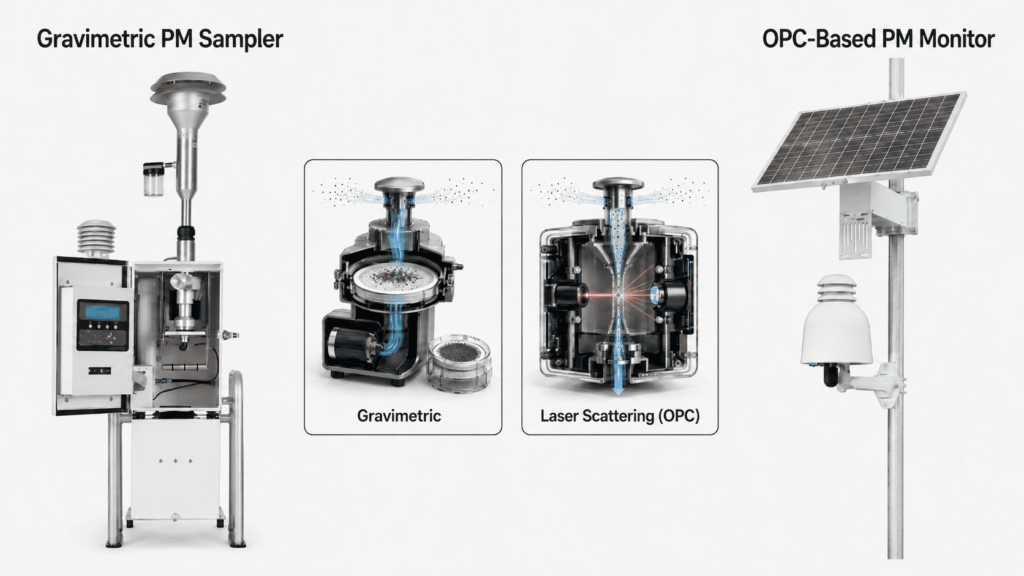
Two sensor systems exposed to the same air can produce different raw responses. Manufacturing tolerances, sensing chemistry, optical design, inlet geometry, electronics and previous exposure all influence the measurement chain. Temperature and relative humidity can shift gas-sensor baselines or affect response; interfering gases can influence selectivity; and optical particulate measurements can change with aerosol composition and water uptake. Over time, contamination, component ageing and sensor drift can alter the relationship again.
Calibration is the process used to characterize that relationship under defined conditions. In practical air-sensor work, it often means comparing a sensor system with a higher-quality reference measurement or known test atmosphere, then deriving a function that maps the sensor response – sometimes together with environmental variables – to a measurement result. The objective is not to make every sensor produce the same number. The characterization is used to understand systematic behaviour; where justified, it can support a subsequent adjustment of the measuring system or correction of the reported result so the measurement approach is suitable for the intended use.
That distinction matters operationally. A network used to detect short events, compare locations or support a research campaign may need a different level of characterization from a system intended to contribute to a formal ambient-air assessment. The required data quality should therefore be defined before the calibration plan, not inferred after data have already been collected.
Calibration and correction cannot fix every measurement problem
A correction model cannot recover information that the measurement system never captured reliably. Severe cross-sensitivity, insufficient sensitivity near the concentrations of interest, unstable sampling flow, blocked inlets, condensation, missing data or a sensor operated outside its characterized environmental range can all limit the value of post-processing. A complex model may reduce error in a calibration dataset and still perform poorly when the pollutant mixture, season, site or sensor condition changes.
For this reason, calibration should be treated as part of system design and quality management rather than as a final software step applied to otherwise uncontrolled data.
Calibration, adjustment, correction, verification and validation are related – but not identical
The International Vocabulary of Metrology gives calibration a precise metrological meaning: it establishes a relationship between values provided by measurement standards and corresponding indications, then uses that information to obtain a measurement result. It also explicitly distinguishes calibration from adjustment, correction, verification and validation. Air-sensor literature and software documentation often use “calibration” more broadly, especially when a statistical correction model is fitted and then applied to field data. The terminology should therefore be made explicit whenever a project specification, report or dataset is reviewed.
| TERM | PRACTICAL MEANING | QUESTION IT ANSWERS |
|---|---|---|
| Calibration | Establishes the relationship between instrument indication and known/reference values under specified conditions. | What relationship links the instrument response to the measurand? |
| Adjustment | Operations carried out on a measuring system so that it provides prescribed indications corresponding to given values of the quantity being measured. | Has the measuring system itself been changed so that its indication behaves as intended? |
| Correction | Compensates for an estimated systematic effect in the measurement result; the correction may be additive, multiplicative or model-based. | How is a characterised systematic effect compensated in the reported result? |
| Verification | Provides evidence that specified requirements are fulfilled. | Does the system meet the stated requirement after setup, service or adjustment? |
| Validation | Provides evidence that the specified requirements are adequate for the intended use; for statistical calibration models, this normally includes testing performance on data independent of those used for model fitting. | Are the verified requirements and achieved performance adequate for the intended use? |
| Recalibration | Repeats characterization when time, maintenance, replacement or changed conditions may have altered the relationship. | Has the relationship changed enough to require a new model or adjustment? |
These terms are not semantic trivia. If a supplier says a sensor is “calibrated”, a technical buyer should still ask what was compared, under what conditions, which model or correction was applied, how performance was validated and how long that characterization is expected to remain representative.
Why sensor response changes in the field
Sensor-to-sensor variability
Nominally identical sensing elements do not always have identical sensitivity, baseline or ageing behaviour. A network-level calibration strategy therefore needs to decide whether one generic model is adequate, whether device-specific coefficients are required, or whether units can be grouped only after evidence shows sufficiently similar performance.
Temperature, humidity and environmental response
Environmental variables can affect both the sensing element and the sampled pollutant. Electrochemical and metal-oxide gas sensors can show temperature- and humidity-dependent response. Optical particulate measurements can be influenced by humidity because hygroscopic particles absorb water and scatter more light. Environmental compensation can be useful, but it should be based on measured behaviour of the complete sensor system rather than on an assumed generic correction.
Interferences and atmospheric composition
A sensor may respond partly to substances other than the intended target. The size and direction of that response depend on sensor technology, concentration range, filters, operating conditions and the local atmospheric mixture. A calibration obtained in one environment can therefore lose accuracy when the interference pattern changes. This is particularly important when a model uses correlated pollutants as predictors: good statistical fit does not prove that the sensor is selectively measuring the target gas.
Drift, contamination and component ageing
Sensor response can change gradually with time. Drift may affect baseline, sensitivity or both; optical systems can be affected by particle deposition and fan or flow changes; electrochemical cells age; lamps, heaters and other components have their own maintenance mechanisms. Drift does not imply that every sensor has a fixed universal recalibration interval. It means the project needs evidence-based checks capable of detecting when the original relationship is no longer adequate.
How air quality sensor calibration is performed
There is no single best calibration method. Laboratory characterization, field collocation and model-based correction answer different questions and are often combined. The appropriate method depends on the pollutant, sensing technology, concentration range, intended evidence role and resources available for verification.
| APPROACH | WHAT IT USES | STRENGTH | LIMITATION |
|---|---|---|---|
| Laboratory / controlled exposure | Known test atmospheres, zero/span checks or controlled aerosol/environmental challenges. | Traceable inputs, repeatable tests, useful for sensitivity, offset, interference and environmental-response characterization. | May not reproduce the full ambient mixture, aerosol properties or field operating history. |
| Field collocation | Sensor system operates beside a suitable reference monitor while both sample the same ambient conditions. | Captures real meteorology and pollutant mixtures; supports site-specific field characterization. | Model can be site-, season- or range-dependent; collocation period must be representative. |
| Statistical / multivariable model | Uses reference comparison data plus sensor and environmental variables to predict the target concentration. | Can address nonlinear response and environmental effects when supported by enough representative data. | Can overfit; high complexity does not guarantee transferability or causal selectivity. |
| Ongoing checks / recalibration | Repeated comparison, zero/span or other verification after deployment. | Detects drift, service effects and model deterioration over time. | Frequency is project-specific; a calendar interval alone is not evidence of maintained performance. |
Laboratory calibration and zero/span checks
For compatible gas-sensing systems, controlled zero and span exposures can characterize offset and sensitivity using known gas concentrations. Environmental chambers can also be used to explore temperature, humidity or interfering-gas effects. Particulate systems require different test approaches, such as controlled aerosol generation and appropriate comparison instruments. Laboratory tests are valuable because inputs can be controlled, but they should not be assumed to reproduce every condition encountered outdoors.
Field collocation with reference instrumentation
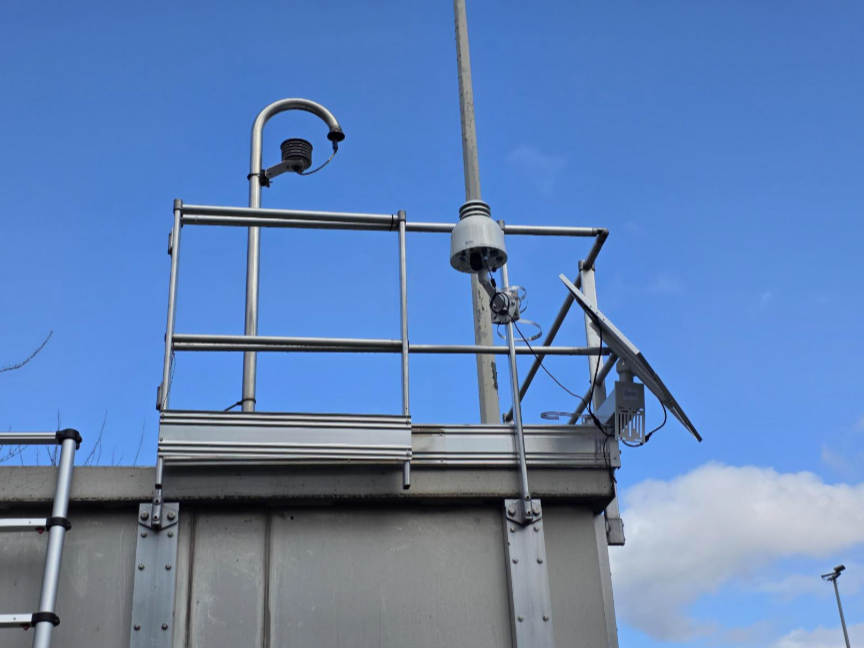
Collocation places the sensor system close enough to a suitable comparison instrument that both experience substantially the same ambient air during the comparison period. Timestamps and averaging intervals must also be aligned. The goal is not merely to obtain a high correlation coefficient; the comparison should examine agreement, bias or error, response across the concentration range, environmental dependence, completeness and stability over time.
Current U.S. EPA collocation guidance is written for U.S. air-sensor users and is not European regulation, but its central technical principle is transferable: comparison with regulatory/reference monitoring can help characterize sensor accuracy and identify when correction is needed. For European projects, the formal role of the data must still be assessed against the applicable European framework.
Calibration models need independent validation
A model should not be judged only on the data used to create it. If the same observations are used both to fit and evaluate the model, performance can look better than it will be in subsequent deployment. A defensible workflow therefore reserves independent data, a later time period or another appropriate validation set to test whether the relationship generalizes. Correlation alone is not enough: a system can track rises and falls while remaining systematically biased.
The calibration dataset should also cover the conditions the model is expected to encounter. A model trained only during one season, within a narrow concentration range or under limited humidity may be unreliable outside that range. European Commission JRC field work has shown that the performance and persistence of calibration models can vary by pollutant, sensor type, temperature range, site, season and time since calibration. The practical lesson is to verify transferability rather than assume it.
Calibration is a lifecycle, not a one-time setup step
A useful calibration programme begins before deployment and continues through operation. The exact activities differ by technology and project, but the lifecycle usually includes a defined monitoring objective, initial characterization, model selection, independent validation, deployment, routine quality checks, review for drift or changed conditions, and recalibration or model revision when evidence shows it is needed.
The European Commission JRC guidance for air-sensor networks treats calibration intervals, model evaluation, drift, QA/QC, recalibration and network data management as connected operational tasks. That is a more useful way to think about data quality than asking for a single universal “calibration frequency”.
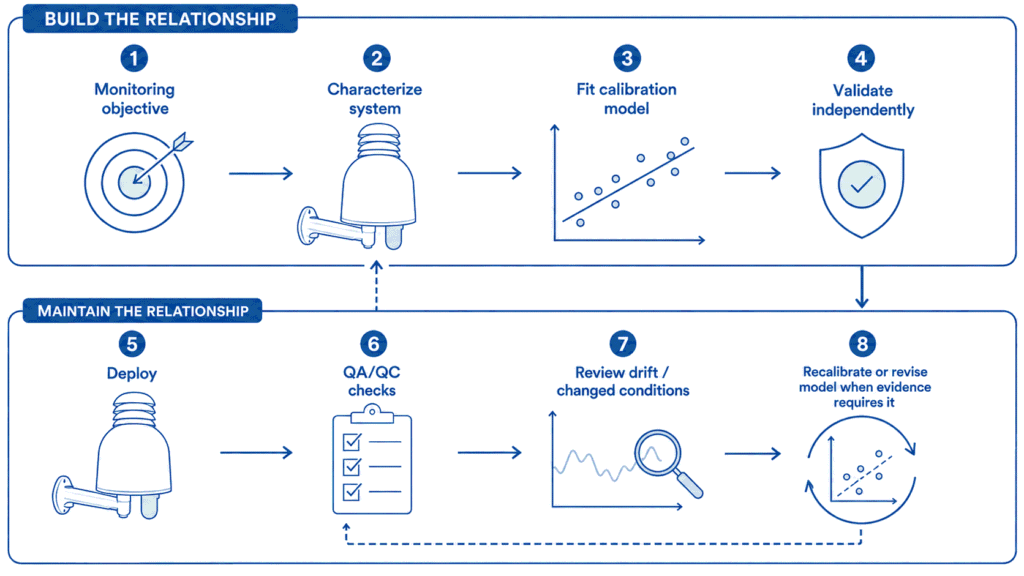
Recalibration may be triggered by elapsed time, but it can also be triggered by evidence: a comparison check shows growing bias; a sensor or module is replaced; a sampling path or firmware change alters system behaviour; seasonal conditions move outside the original calibration domain; or maintenance changes the measurement chain. The trigger should be documented so that a historical dataset can be interpreted alongside the calibration state of the system.
Calibration is only one part of data quality
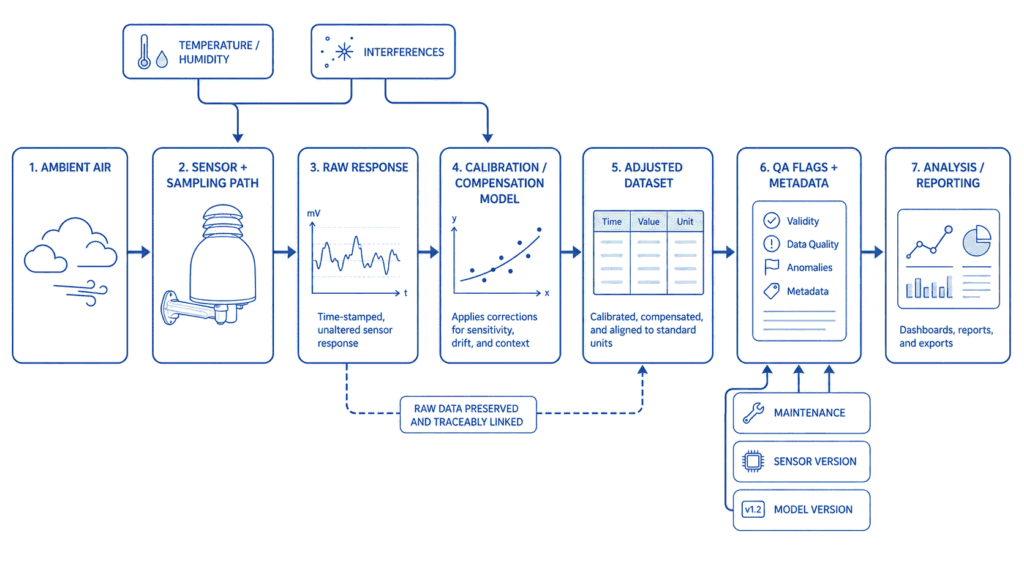
A calibrated channel can still produce poor data if the surrounding data workflow is weak. Long-term data quality depends on the complete measurement chain: the physical instrument, calibration state, device health, timestamps, data transmission, QA flags, maintenance records, processing versions and the ability to trace reported values back to the original measurements.
Data completeness and time alignment
Missing values, duplicated records, clock drift or mismatched averaging intervals can distort comparisons and event interpretation. Before a calibration model is fitted or a network is compared, the data streams should be aligned consistently and periods affected by faults or maintenance should be identified.
Raw and adjusted data should remain distinguishable
Once corrections are applied, the adjusted concentration becomes a derived dataset. Preserving the relationship to the original sensor output improves traceability: analysts can reproduce processing, assess the effect of a revised calibration model and distinguish a real environmental change from a change in data treatment. For distributed networks, centralized model versioning and recalculation can be especially useful when the same rules must be applied consistently across devices.
QA flags, maintenance and metadata provide interpretation context
A concentration value without context is incomplete evidence. Useful metadata can include device identity, sensor or module version, calibration date and model version, service events, inlet or filter changes, known instrument faults, environmental range, QA status and the averaging procedure used for reporting. These records do not make the measurement more accurate by themselves; they make its quality and limitations more visible.
What a good calibration programme should demonstrate
A calibration programme is stronger when it can answer a small set of practical questions clearly:
- What is the monitoring objective, pollutant and concentration range that the data must support?
- What reference, test atmosphere or comparison method was used, and is it appropriate for the target measurement?
- Did the calibration dataset cover representative concentrations, meteorology and relevant interferences?
- Was the correction model validated on independent data rather than only on the fitting dataset?
- Which performance measures were reviewed – for example bias/error, uncertainty where applicable, completeness and stability – rather than relying only on correlation?
- How are model versions, raw data, adjusted data, QA flags and service history kept traceable?
- What evidence or event triggers recalibration, revalidation or a change in the model?
These questions are more informative than asking whether a device has been “factory calibrated” in the abstract. Factory or laboratory characterization can be an important starting point, but long-term field performance depends on how well that characterization represents the actual application and how effectively change is detected over time.
Calibration and formal indicative measurement are not interchangeable
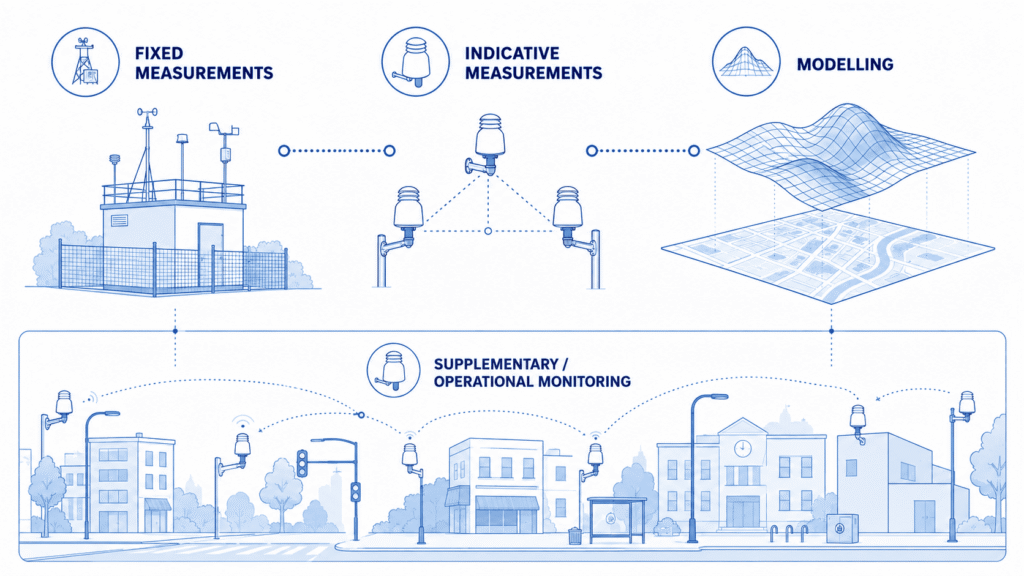
In Europe, Directive (EU) 2024/2881 distinguishes fixed measurements, indicative measurements, modelling and other assessment approaches. Indicative measurement is therefore an assessment role with defined data-quality objectives, not a synonym for “calibrated sensor”. The Directive also requires quality-assurance and quality-control systems for formal ambient-air assessment, including maintenance, technical checks, data collection and reporting controls.
The European CEN/TS 17660 series provides performance-evaluation procedures for sensor systems measuring gaseous pollutants and particulate matter at fixed ambient sites. Those procedures are useful for structured testing, but a performance result under specified test conditions should not be generalized automatically to different sites, climates or operating periods. The applicable pollutant, measurement method, achieved performance and assessment framework all matter.
For operational, research or supplementary monitoring, the required quality framework may be different from formal ambient-air assessment. The same principle still applies: calibration should be designed around the decision the data need to support, and limitations should remain visible in the interpretation.
How Aernode approaches calibration and data quality
The Aernode Air Quality Monitor is designed for continuous outdoor sensor-based monitoring, while Aernode Cloud provides the centralized data layer for calibration management, post-processing and long-term network data handling. Raw sensor measurements are preserved alongside adjusted datasets, so calibration and compensation models can be managed without erasing the original measurement stream.
Calibration strategy is selected according to pollutant, sensor technology, site conditions and required data quality. Current Aernode workflows can include field collocation with reference instrumentation and, for compatible gas channels, controlled checks using certified gas mixtures. Cloud-side post-processing allows adjusted datasets to be updated consistently when calibration models change while keeping the raw record available for traceability.
This approach is relevant to multi-node operational networks and to research deployments where analysts may need to understand how the processed concentration was derived from the original sensor output. It does not mean that calibration automatically gives every channel formal indicative-measurement status or makes a compact monitor equivalent to a regulatory reference station. Formal suitability depends on the complete measurement system, achieved data quality and applicable assessment framework.
A practical calibration checklist for sensor-based monitoring projects
Before a long-term deployment is approved, confirm the following:
- Define the decision the data must support and the required data quality before choosing the calibration method.
- Confirm the relevant pollutant range, environmental conditions, likely interferences and sensing technology.
- Choose a suitable characterization method: controlled laboratory testing, field collocation, or a justified combination.
- Separate model fitting from validation and document the data, reference method, averaging and performance measures used.
- Preserve raw data, adjusted data, calibration-model versions and QA metadata so processing remains traceable.
- Define ongoing checks and evidence-based recalibration triggers, especially after service, sensor replacement or changed operating conditions.
- Treat regulatory or formal indicative-measurement requirements as a separate conformity question under the applicable framework.
Conclusion: calibration is part of the measurement system, not a one-off correction
The most important question is not whether an air-quality sensor has been calibrated once. It is whether the complete measurement system has been characterized for the intended use, whether the calibration relationship has been validated under representative conditions, and whether the project can detect when that relationship changes.
Good sensor-based monitoring therefore combines calibration with field verification, QA/QC, maintenance, transparent data processing and documented limitations. When those elements are managed as a lifecycle, continuous sensor networks can provide far more defensible evidence for environmental analysis, operational decisions and research than a calibration certificate or correction equation can provide on its own.