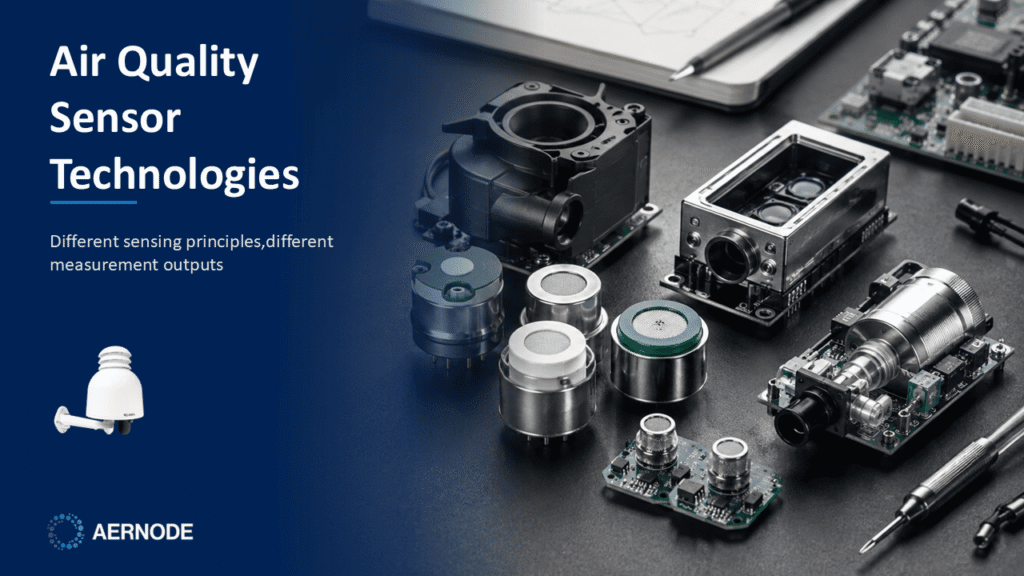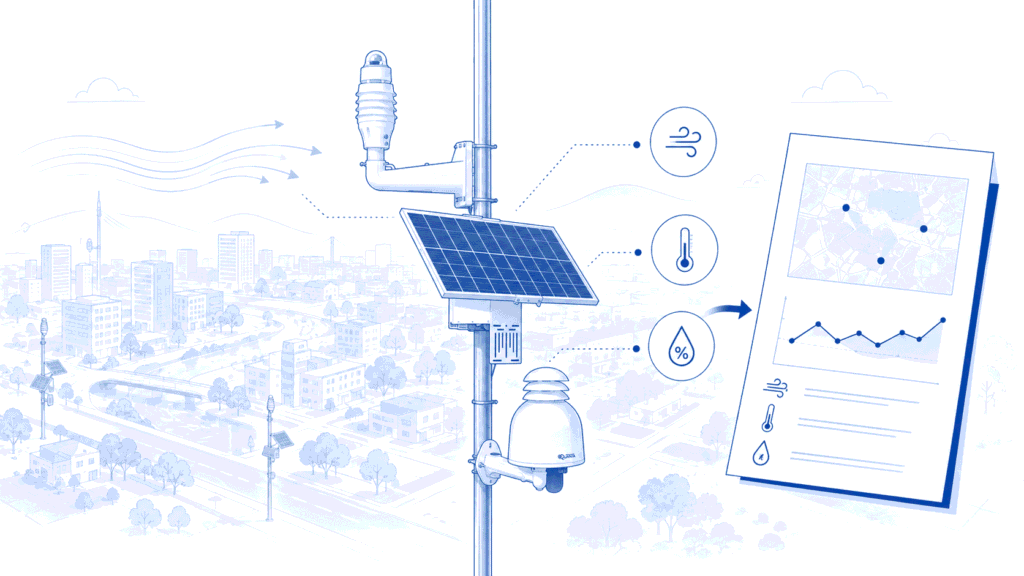
Electrochemical gas sensors are compact sensing elements that convert an oxidation or reduction reaction involving the target gas into an electrical signal. In continuous ambient-air monitoring they are commonly used for gases such as nitrogen dioxide (NO2), ozone (O3), carbon monoxide (CO), sulfur dioxide (SO2), nitric oxide (NO) and hydrogen sulfide (H2S). The same electrochemical sensing principle is also used in sensor families designed for application-specific industrial gases and different concentration ranges. Their practical value is clear: they can operate at low power, fit inside compact outdoor monitors and support time-resolved measurements across multiple locations.
The difficult part is not simply detecting a gas. Ambient concentrations can be far lower than those encountered in many higher-range gas-monitoring applications, so cross-sensitivity, temperature and humidity, baseline current, calibration, ageing and the complete monitor design can become significant parts of the measurement. This Guide focuses on amperometric electrochemical gas sensors used in continuous outdoor environmental monitoring, including low-concentration ambient-air applications and application-specific industrial gas measurement. It does not cover occupational safety alarms, reference analysers or every electrochemical sensing architecture.
How an electrochemical gas sensor works
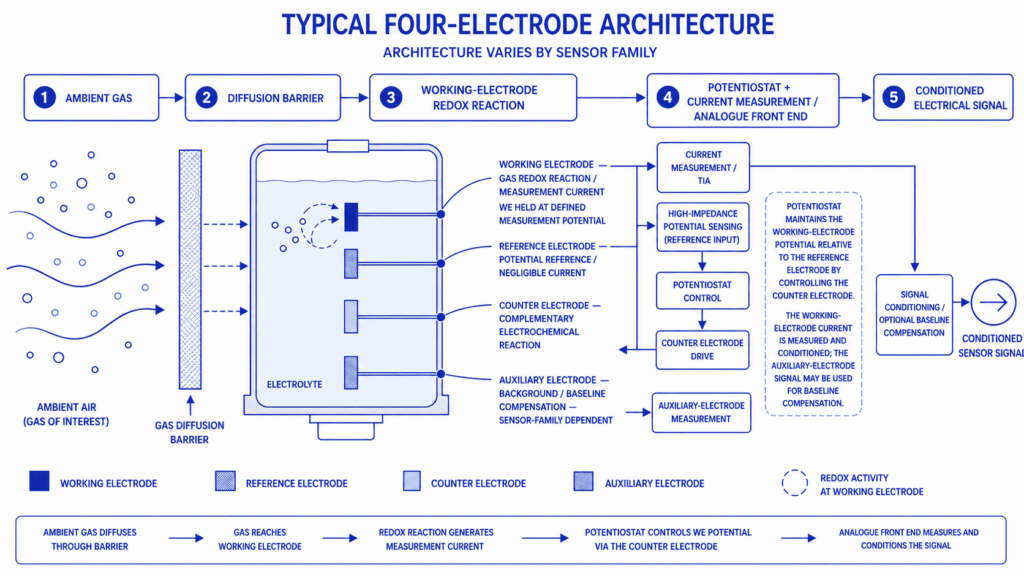
In a typical amperometric sensor, ambient gas reaches the sensing cell through a diffusion barrier. At the working electrode, the target gas is oxidized or reduced. The resulting electrochemical reaction generates a current that, within the sensor’s intended operating range, can be related to the concentration reaching the electrode.
A reference electrode provides a stable electrochemical potential reference. The potentiostat or analogue front end uses that reference to maintain the working electrode at the required potential, while the counter electrode carries the complementary electrochemical current. Some widely used ambient-air sensor families add a fourth, auxiliary electrode to help track background currents or environmental effects that are not caused by the target gas. The exact architecture and correction method are sensor-family specific.
The important point is that the sensor does not directly output an air-quality concentration in ppb or micrograms per cubic metre. It produces an electrical signal. The monitor’s analogue front end, temperature and humidity measurements, calibration coefficients, compensation logic and data-processing chain are all part of the conversion from sensor current to a reported concentration.
Electrochemical gas sensing is based on redox reactions, and suitable sensor families can be configured for gases including NO2, NO, O3 and CO. Temperature and humidity response, cross-reactivity and finite operating life are also important system-design considerations. That distinction matters: a sensor element can be technically capable while the quality of the final concentration depends on how the complete measurement system is designed and validated.
Electrochemical sensors are designed for different concentration ranges
Electrochemical sensing is a measurement principle, not a single concentration class. Different sensor families can use the same basic amperometric architecture while being optimized for different measurement ranges, sensitivities, selectivity profiles, environmental conditions, exposure tolerance and operating life. A gas name alone therefore does not identify the appropriate sensor family: the intended application and concentration range matter.
In low-concentration ambient-air monitoring, pollutant changes may be in the low-ppb range. At those levels, baseline current, electrical noise, cross-sensitivity, temperature and humidity response, calibration uncertainty and long-term drift can be large relative to the target signal. The complete sensing system – cell chemistry, diffusion path, analogue front end, environmental measurements, compensation, calibration and QA/QC – determines whether the reported variation is stable and defensible.
The same principle also supports application-specific industrial gas monitoring and process-related environmental measurement, where expected concentrations and performance priorities may be different. A sensor family may be optimized for a different operating range, sensitivity, exposure tolerance, selectivity balance or lifecycle. That does not make one class inherently better; it means the system design must match the monitoring objective.
Sensor selection should therefore begin with the target gas, expected concentration range and monitoring objective, then verify the sensor family, operating range, sensitivity, interferents, environmental conditions, lifecycle and calibration strategy.
Why electrochemical sensors are useful for continuous air-quality monitoring
Sensitivity at ambient concentrations
For ambient-air monitoring, the challenge shifts toward resolving pollutant changes at concentrations far below many traditional higher-range gas-sensing applications. Suitably designed electrochemical sensor systems can resolve low-concentration ambient variations for several gases when the sensor family, analogue front end, calibration and operating conditions are appropriate. The practical limit is system-dependent: the same electrochemical technology label does not guarantee equivalent performance across sensor families, pollutants or environmental conditions.
That makes electrochemical sensing useful where the project question depends on continuous gas information rather than only occasional or spatially sparse measurements. The relevant advantage is not that every electrochemical sensor is automatically accurate at ambient concentrations. It is that the technology can provide a workable sensing layer for certain pollutants when the sensor family, electronics, calibration and field conditions are matched to the application.
Compact, low-power, multi-point deployment
Electrochemical cells are small and require little power compared with many reference analyser technologies. A compact monitor can therefore combine several gas sensors with particulate, meteorological or other environmental measurements and transmit data from locations where a full reference station would be impractical.
For environmental consultants, researchers and operators, this can support denser spatial coverage, repeated comparisons between locations and longer deployments within a practical network architecture. The measurement benefit comes from the network and time series, not from treating the sensor as a miniature reference analyser.
Time-resolved information
Continuous acquisition can show when a gas concentration changes, how long an event persists and whether similar patterns recur. That is useful for investigating traffic-related variation, process-related events, fenceline conditions, research questions and other time-dependent phenomena.
However, the monitor’s reporting interval should not be confused with validated measurement time resolution. A system may transmit values every few seconds while requiring longer averaging periods to achieve stable and defensible ambient-gas measurements. Temporal resolution should therefore be demonstrated for the complete measurement system rather than inferred from transmission frequency alone.
The main limitations in outdoor ambient monitoring
Cross-sensitivity and selectivity
An electrochemical sensor is designed to favour a target reaction, but other gases can also generate a response. This is cross-sensitivity. Interference magnitude and direction are sensor-family specific and depend on electrode chemistry, operating potential, filters, sensor design and the atmospheric mixture.
The practical consequence is that a channel labelled NO2, O3, CO or SO2 should not automatically be interpreted as containing only the target-gas contribution. Co-pollutants may contribute positively or negatively, so selectivity must be evaluated for the sensor family and intended operating conditions.
Where humidity or co-pollutants produce sensor-family-specific effects that have been characterised, compensation may improve the reported result. However, those interference relationships cannot automatically be transferred between sensor families or across different environmental and operating conditions. No universal interference or correction matrix should therefore be assumed.
Temperature and humidity effects
Temperature can change sensor sensitivity, reaction kinetics and background current. Humidity can alter the electrolyte state and can introduce transient or sustained changes in response. Rapid changes can be particularly difficult because the sensor and its surrounding enclosure may not equilibrate instantly.
At low ambient concentrations, temperature, humidity and background-current behaviour can become material contributors to measurement uncertainty. This is one reason outdoor monitors commonly measure local temperature and relative humidity alongside electrochemical channels and use those variables in compensation or quality-control logic. The effect and appropriate correction remain sensor- and system-specific.
Environmental compensation is not a guarantee of correctness. A model trained over one range of temperature, humidity and pollutant mixtures may perform less well when deployed outside that range. Field validation should therefore expose the system, as far as practical, to conditions representative of the intended deployment.
Baseline current, noise and low-concentration uncertainty
Even in clean air, an electrochemical cell can produce a non-zero background signal. At relatively high target concentrations, this offset may be small compared with the analytical signal. At low ambient concentrations, baseline current, electronic noise and small environmental shifts can become a much larger fraction of the result.
This is why a manufacturer’s technical detection limit should not be interpreted as a universal guarantee of quantitative field performance. Detection, stable quantification and fit-for-purpose operational use are different questions. The complete system has to demonstrate adequate performance over the concentration range that matters to the project.
Drift, ageing and sensor-to-sensor variation
Electrochemical sensors are finite-life, replaceable measurement components. Their response can change with age, cumulative exposure, environmental stress and storage or operating conditions. Two nominally identical sensors may also have different sensitivity or baseline characteristics.
For a multi-year network, sensor life therefore belongs in the data-quality plan as well as the maintenance plan. Replacement should trigger the appropriate configuration, calibration or verification steps rather than being treated as a purely mechanical service action. A fixed universal replacement interval is not technically appropriate across every gas and sensor family.
Response time, averaging and event interpretation
Gas diffusion through the barrier, electrochemical reaction kinetics, electronic filtering and software averaging all influence the speed and shape of the reported response. A fast-changing time series may contain genuine atmospheric structure, sensor dynamics, or both.
When short events matter, specify the sensor response time, system sampling interval, reported averaging period and validated time resolution separately. This avoids a common mistake: assuming that a one-minute dashboard value necessarily represents a one-minute accurate measurement of the ambient gas concentration.
Calibration and system integration turn sensor response into a usable measurement
An electrochemical sensor’s raw electrical response, read through the analogue front end, usually requires several transformations before it becomes a useful ambient concentration. The exact workflow varies, but a defensible system typically has to address zero/baseline, sensitivity, temperature and humidity dependence, known interfering gases and changes over time.
Calibration can use laboratory exposures, field co-location with suitable reference instrumentation, or a combination. Laboratory work makes it possible to challenge the sensor with controlled concentrations and environmental conditions. Field co-location tests how the complete monitor behaves in a real atmospheric mixture, including variables and interferences that are difficult to reproduce fully in a chamber.
The strongest approach is fit-for-purpose rather than formula-driven. The calibration and validation design should reflect the target pollutant, expected concentration range, meteorology, co-pollutants, required averaging period and the decision the data will support. For research deployments, repeat or end-of-campaign co-location can help identify drift and changes in sensor behaviour over time.
No correction model creates information that the sensor did not contain. If the target signal is too close to background variability, if a major interferent is unmeasured, or if field conditions fall outside the calibration domain, uncertainty remains. Good processing should make those limits visible rather than hide them behind a smooth time series.
What to verify before selecting an electrochemical gas sensor
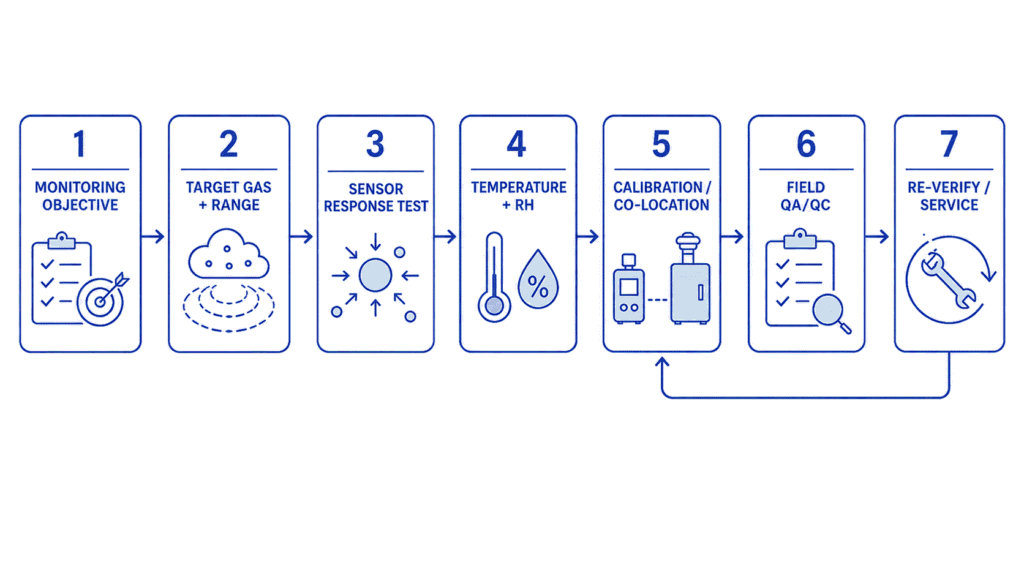
A useful specification starts with the monitoring question and works backward to the sensing system. The table below summarises the checks that matter most.
| Question | Why it matters | What to verify |
|---|---|---|
| What gas is the project trying to measure? | Electrochemical cells are designed for a target gas but are not perfectly selective. | Target gas, sensor chemistry, filters and relevant interferents. |
| What concentration range is expected? | Electrochemical sensor families can be designed for very different concentration ranges; low-concentration ambient measurement places different demands on baseline stability, interference control and calibration than higher-range application-specific monitoring. | Expected concentration range, recommended operating range, sensitivity, lower operational range / quantification capability and required resolution. |
| Which co-pollutants are present? | Cross-sensitivity can bias the target channel. | Cross-sensitivity data for the exact sensor family and whether interferents are measured or filtered. |
| What temperature and humidity range will occur? | Environmental conditions can change sensitivity and baseline. | Rated range, compensation method and validation conditions. |
| How fast must the measurement respond? | Transmission frequency is not the same as measurement response. | Sensor response time, sampling rate, averaging and validated temporal resolution. |
| How will concentration be calculated? | The sensor outputs an electrical signal, not a self-validating concentration. | Analogue front end, baseline treatment, calibration equation and compensation inputs. |
| How will performance be verified in the field? | Laboratory calibration may not capture the full atmospheric mixture. | Co-location or comparison strategy, QA/QC checks and re-verification plan. |
| What is the lifecycle plan? | Sensitivity and baseline can change with age and replacement. | Operating-life guidance, service triggers, replacement calibration and traceability. |
What electrochemical sensor data can – and cannot – support
When the sensing system is properly selected, calibrated and quality-controlled, electrochemical gas measurements can support continuous trend analysis, event detection, comparison between monitoring locations, field research and supplementary environmental investigation. They are particularly useful when the monitoring question benefits from more temporal or spatial information than a sparse set of reference instruments can practically provide.
They should not be treated as automatic proof of source attribution. A concentration increase does not, by itself, identify which process or source caused it. Meteorology, spatial comparisons, process context and other measurements may be needed before a defensible interpretation can be made.
The sensor technology label also does not define regulatory status. Under Directive (EU) 2024/2881, fixed and indicative measurements are formal assessment categories linked to specified data-quality objectives and measurement requirements. An electrochemical sensor does not become an “indicative measurement” merely because it is compact or sensor-based, and it does not become a reference method because a correction model performs well under one set of validation conditions. Regulatory suitability must be assessed for the complete method and intended use.
How Aernode uses electrochemical gas sensing
Within Aernode Sensor Kits, the Sensor Deck provides a configurable gas-sensing layer for the outdoor monitoring station. Depending on project configuration, current Sensor Deck options include ambient-air gases such as NO2, O3, CO, SO2, NO and H2S, together with application-specific electrochemical options such as NH3, Cl2, HCl, HCN, H2O2, PH3 and ETO. The relevant sensor family is selected according to the target gas, expected concentration range, sensitivity, environmental conditions, cross-sensitivities, lifecycle and calibration strategy rather than from the gas name alone.
The Sensor Deck is designed as a replaceable sensing assembly, which allows gas-sensing components to be serviced according to their lifecycle without replacing the complete station. That matters because electrochemical sensors age at different rates and may require configuration-specific replacement and verification.
For research and validation work, Aernode deployments can include co-location with reference instrumentation and study-specific QA/QC, calibration and correction procedures. The monitoring architecture should follow the research or operational question: the useful result is a traceable measurement workflow, not simply a live number from a sensor.
The practical takeaway
Electrochemical gas sensors are valuable in ambient air-quality monitoring because they combine compact size, low power demand and sensitivity that can support continuous measurements of several important gases. Those strengths make distributed monitoring and time-resolved investigation practical in projects where reference instrumentation at every location would be impractical.
Their limitations are equally central to the decision. Cross-sensitivity, environmental effects, baseline behaviour, calibration, temporal response, ageing and the rest of the measurement system determine what the reported concentration can support. The right way to evaluate an electrochemical sensor is therefore not to ask whether the technology is “accurate” in the abstract. Ask whether the specific sensor and complete monitor have been selected, calibrated and verified for the pollutant, concentration range, environment, time scale and decision at hand.
Technical references
1. Yatkin S, Gerboles M, Borowiak A, Signorini M. Guidance on low-cost air quality sensor deployment for non-experts based on the AirSensEUR experience. European Commission Joint Research Centre, EUR 31274 EN, 2022. doi:10.2760/180094.
2. Williams DE. Electrochemical sensors for environmental gas analysis. Current Opinion in Electrochemistry. 2020;22:145-153. doi:10.1016/j.coelec.2020.06.006.
3. Mead MI et al. The use of electrochemical sensors for monitoring urban air quality in low-cost, high-density networks. Atmospheric Environment. 2013;70:186-203. doi:10.1016/j.atmosenv.2012.11.060.
4. Pang X, Shaw MD, Gillot S, Lewis AC. The impacts of water vapour and co-pollutants on the performance of electrochemical gas sensors used for air quality monitoring. Sensors and Actuators B: Chemical. 2018;266:674-684. doi:10.1016/j.snb.2018.03.144.
5. Spinelle L, Gerboles M, Kotsev A, Signorini M. Evaluation of low-cost sensors for air pollution monitoring: Effect of gaseous interfering compounds and meteorological conditions. European Commission Joint Research Centre, EUR 28601 EN, 2017. doi:10.2760/548327.
6. Schmitz S, Caseiro A, von Schneidemesser E. How electrochemical sensors measure up to reference-grade nitrogen dioxide monitors across temporal scales. Science of the Total Environment. 2025;980:179476. doi:10.1016/j.scitotenv.2025.179476.
7. European Parliament and Council. Directive (EU) 2024/2881 on ambient air quality and cleaner air for Europe (recast), 23 October 2024.