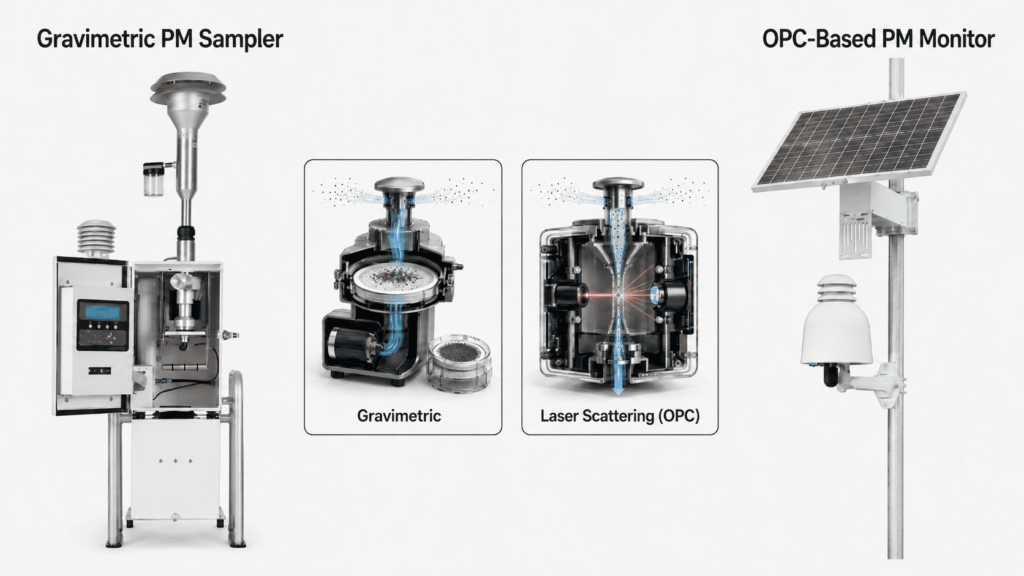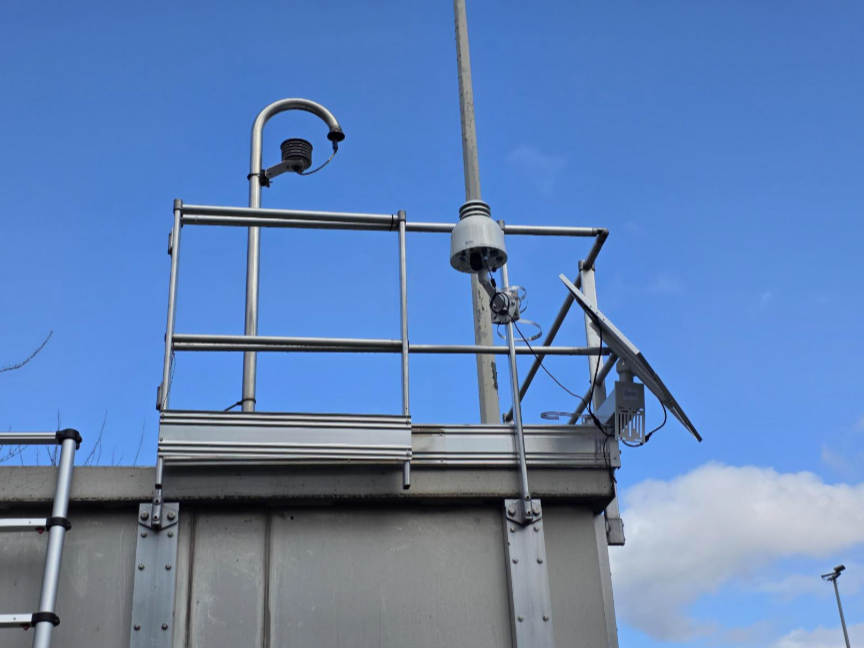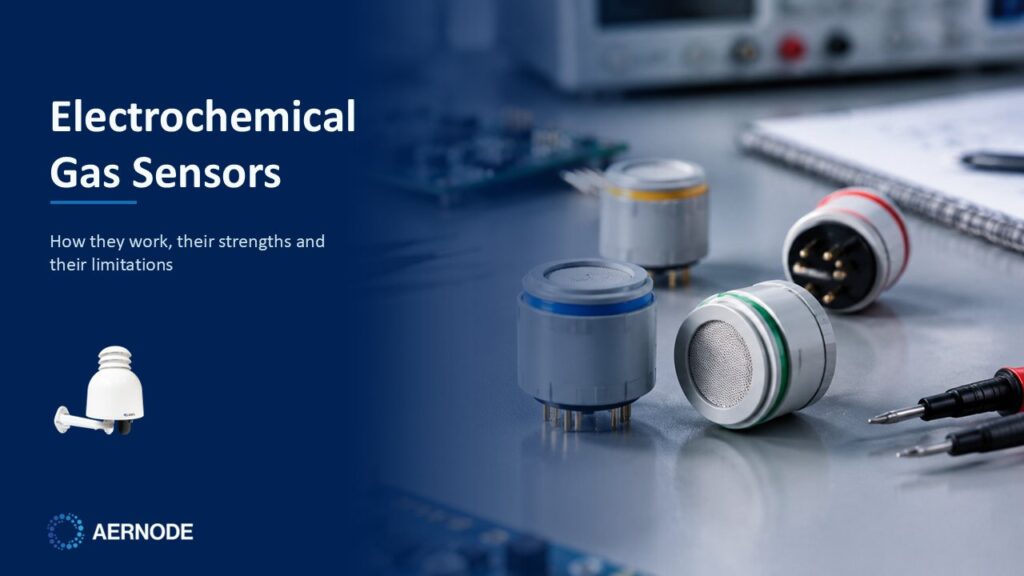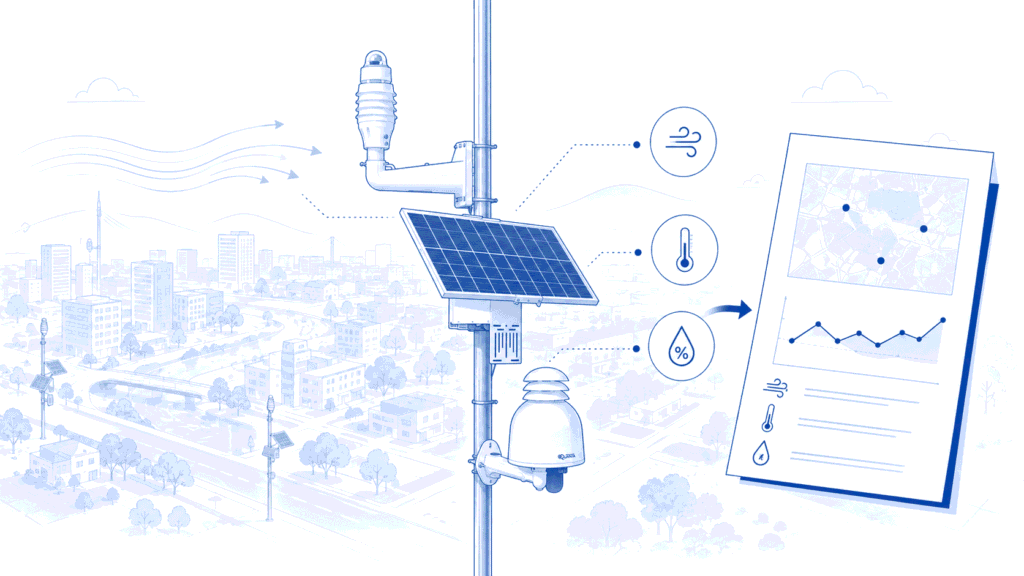
Air-quality measurement covers a wide range of methods. This Guide focuses on five technology families commonly used in compact, continuous, sensor-based monitoring: OPC, electrochemical, NDIR, PID and MOX. They are widely used because they can support continuous time-series data, compact outdoor instruments, multi-parameter configurations and deployment across many monitoring points, often with less infrastructure and lower deployment burden per point than traditional reference-grade analysers. That practical advantage does not make the measurements equivalent to reference methods: calibration, selectivity, stability, environmental response and the intended evidence role still determine what the data can support. This is not a catalogue of every technology used to measure air pollution. Gravimetric particulate measurement, beta attenuation, chemiluminescence, UV photometry and chromatographic or laboratory speciation are outside scope here because they serve different measurement roles. The aim is to understand what these five sensor outputs mean and how to select a fit-for-purpose technology.
That network-level advantage is economic as well as physical. Smaller sensor-based instruments can reduce instrument footprint, supporting infrastructure and deployment effort per point, which can make denser or multi-point continuous networks economically feasible. Purchase price, however, is only one part of lifecycle cost. Characterisation, environmental compensation, field verification, recalibration, drift management, maintenance, data correction and QA can all contribute to the cost of maintaining useful measurement quality over time.
What these air quality sensor technologies actually measure
A sensor does not simply “read pollution”. It responds to a physical or chemical interaction, converts that response into an electrical signal, and then relies on calibration and, in many systems, further processing to report a useful value. A simplified measurement chain is: air or aerosol -> physical response -> electrical signal -> calibration / algorithm -> reported output.
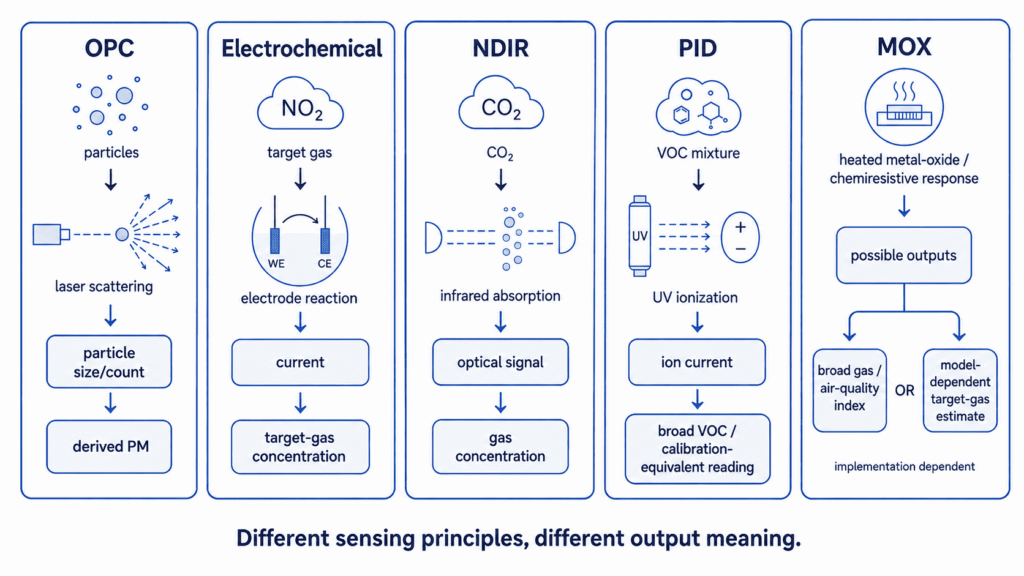
That distinction matters because the reported outputs are not equivalent. An OPC can report particle counts and a derived PM mass concentration. An electrochemical cell can report a concentration for a selected gas after calibration. A PID can provide a broad response to ionizable VOCs. A MOX implementation can expose a raw resistance or conductance response, a processed air-quality / VOC index, or a model-dependent estimate for a target gas. NDIR is commonly used when a specific gas has a suitable infrared absorption band, with CO2 being a familiar example in compact monitoring systems.
The sensor technology therefore determines both what physical property is observed and what interpretation is defensible from the resulting data. Selecting a technology only from the pollutant name on a datasheet can miss that distinction.
Five sensor technologies at a glance
| Technology | Typical target / output | Primary sensing response | Main interpretation limit |
|---|---|---|---|
| OPC | PM1, PM2.5, PM10; particle counts / size bins | Light scattered by individual particles | PM mass is derived from optical sizing and conversion assumptions; aerosol properties, humidity and sampling design matter. |
| Electrochemical | Target gases such as NO2, O3, CO, SO2 or H2S | Current produced by a controlled oxidation or reduction reaction | Cross-sensitivity, baseline behaviour, temperature / humidity and ageing are sensor-specific. |
| NDIR | Commonly CO2 in compact systems | Absorption of infrared light at a characteristic wavelength | Performance depends on optical design, calibration and environmental compensation; it is a gas-specific optical method, not a general VOC sensor. |
| PID | Broad VOC response, depending on lamp energy and compound response | Ionization current created by ultraviolet photons | Not chemical speciation; different compounds can produce different responses and may require response factors. |
| MOX | Reactive-gas sensing; depending on sensing material, operating conditions and system design, implementations may target VOC-related responses, NO2, O3, CO and other gases. | Change in electrical properties of a heated metal-oxide sensing surface. | Selectivity, response shape, environmental dependence, exposure-history effects and long-term stability are strongly implementation-dependent. A MOX output should not automatically be interpreted as a compound-specific concentration unless the complete measurement system and calibration support that claim. |
OPC: light scattering for particulate matter
An Optical Particle Counter draws or allows air through an optical measurement zone. When individual particles cross a laser beam, they scatter light. A photodetector converts the scattered light into an electrical pulse, and the instrument uses the pulse characteristics to estimate optical particle size and count particles across size bins.
For air-quality monitoring, the particle-size distribution is commonly converted into PM fractions such as PM1, PM2.5 and PM10. The important word is converted. An OPC does not weigh airborne particles. Its PM mass output is estimated from optical measurements using assumptions or calibration relationships that connect particle size and count to volume and mass.
This makes OPC technology especially useful for continuous particulate monitoring, because it can show rapid changes and provide several particle fractions from one sensing system. It also creates characteristic limitations. Particle refractive index, shape and density can influence the relationship between scattered light and estimated mass. Hygroscopic particles can grow as relative humidity rises, changing optical response. For coarse particulate matter, inlet geometry, airflow and the ability to transport larger particles through the sampling path can become important.
The technology family alone is therefore not enough to specify field performance. Particle-size detection range, airflow control, inlet design, contamination management, environmental operating range and the mass-conversion algorithm all matter. For a deeper explanation of why optical and reference mass measurements can differ, see OPC vs Gravimetric Particulate Matter Measurement.
Electrochemical sensors: gas concentration from an electrode reaction
Electrochemical gas sensors typically contain a working electrode, a reference electrode and a counter electrode in contact with an electrolyte. The target gas reaches the sensing interface and participates in a controlled oxidation or reduction reaction at the working electrode. The resulting current is measured by the instrument electronics and related to gas concentration through calibration.
This principle is widely used for gases relevant to ambient and industrial environmental monitoring, including nitrogen dioxide, ozone, carbon monoxide, sulfur dioxide and hydrogen sulfide. The cell chemistry, electrode materials, membrane or filter design, bias conditions and electronics are selected for the intended gas and concentration range. Four-electrode designs can add an auxiliary electrode to improve baseline correction, but the details vary by sensor family.
Electrochemical sensing is often described as selective, but it should not be treated as perfectly specific. Other gases may generate a response, and the magnitude of that cross-sensitivity depends on the sensor design. Temperature, humidity, baseline drift, pollutant concentration, exposure history and sensor ageing can also affect the output. Some NO2 sensor designs, for example, use filtering or paired correction specifically to manage ozone interference. For a focused discussion of these field-performance limits, see Electrochemical Gas Sensors for Ambient Air Monitoring: Strengths and Limitations.
For low-concentration outdoor measurements, the practical question is not only whether an electrochemical cell can respond to a gas, but whether the complete sensor system has sufficient sensitivity, stability and compensation for the concentration range and environmental conditions expected in the project.
NDIR: infrared absorption for gas-specific measurement
Non-dispersive infrared sensing uses the fact that many gases absorb infrared radiation at characteristic wavelengths. In a typical NDIR arrangement, an infrared source sends light through a sample path. An optical filter and detector measure the intensity in a wavelength band associated with the target gas, often alongside a reference measurement. The reduction in transmitted intensity is related to gas concentration through the instrument calibration.
In compact environmental systems, NDIR is commonly used for carbon dioxide. It differs fundamentally from electrochemical sensing: the signal comes from optical absorption rather than an electrode reaction. It also differs from PID and MOX approaches because the optical system is designed around a characteristic absorption band of the target gas.
NDIR performance still depends on the complete optical and electronic design. Optical path length, source and detector stability, reference strategy, pressure and temperature compensation, contamination and condensation management can all influence long-term measurement quality. A specification should therefore be evaluated at instrument level rather than assuming that every NDIR implementation is interchangeable.
PID: ultraviolet ionization for broad VOC response
A photoionization detector exposes the sampled gas to high-energy ultraviolet photons. Compounds that can be ionized by the lamp produce charged species, and the resulting ionization current creates the detector signal. PIDs can respond rapidly to a broad range of volatile organic compounds and some other ionizable compounds.
The breadth of that response is both the strength and the limitation. A PID is not a chromatograph and does not identify the individual compounds in a mixture. The signal depends on the compounds present, the lamp energy and their relative response. Instruments are commonly calibrated against a reference compound, and response factors may be used when a specific compound is known.
This means a PID-based “total VOC” or broad VOC value must be interpreted according to the calibration basis and expected mixture. A rising PID signal can be highly useful for detecting a change, locating an event or comparing conditions over time, but it does not by itself reveal which VOC caused the change. For a deeper comparison of PID response and MOX-derived VOC outputs, see VOC Monitoring with Compact Sensors: MOX and PID Explained.
MOX: gas sensing through a heated metal-oxide surface
Metal-oxide sensors – often described as MOX or MOS sensors – are a gas-sensing technology family built around heated metal-oxide materials. Gas interactions at the sensing surface change the element’s electrical resistance or conductivity. The sensing material, catalyst or doping, operating temperature, heater profile, electronics and signal processing all influence which gases produce a useful response and how selective that response can become.
Some MOX implementations are designed around broad VOC or air-quality responses, while other implementations target gases such as NO2, O3 or CO. The technology label therefore does not, by itself, define what the reported value means. The European Commission JRC low-cost sensor overview describes metal-oxide sensors for NO2, O3 and CO and also highlights temperature / humidity dependence, response-history effects and instability as practical limitations.
For outdoor continuous monitoring, selectivity can be limited and response curves may be nonlinear. Temperature and humidity can materially affect behaviour; exposure history and baseline history can alter the response; and drift or surface poisoning can affect long-term stability. Calibration and compensation are therefore strongly model- and application-dependent. A peer-reviewed urban MOX field study using metal-oxide NO2 and O3 sensors illustrates why long-term performance must be monitored rather than inferred from the sensing principle alone.
For long-term monitoring, nominal physical sensor lifetime is less informative than how long the complete measurement channel can maintain the required performance between verification, recalibration or replacement events. A sensor element may continue to operate physically while the measurement channel requires renewed calibration, compensation or maintenance to keep the data comparable.
One common use of MOX technology in compact air-quality systems is a processed VOC or air-quality index. That type of index is a broad relative or processed response: it does not provide compound speciation and should not automatically be interpreted as a quantitative total-VOC concentration. It is one MOX implementation, not the definition of MOX as a technology family.
Why sensor outputs are not interchangeable
The same dashboard can display values from several sensors, but that does not make the underlying measurements equivalent. The five technologies covered here can produce several different kinds of information:
- a derived particulate mass concentration based on optical particle measurements;
- a target-gas concentration from a calibrated electrochemical response;
- a gas-specific concentration from infrared absorption;
- a broad VOC response from a PID; and
- a raw resistance / conductance response, processed index or model-dependent gas estimate from a MOX implementation.
VOC monitoring remains a useful example. A PID responding to a mixture of ionizable compounds and a MOX system reporting a processed VOC or air-quality index can both react to an air-quality event, but they answer different questions. A PID output depends on ionization energy, calibration basis and mixture composition; a MOX index depends on the sensing element, heater strategy, compensation and algorithm. Neither output provides chemical speciation by itself.
The output type depends on the complete MOX implementation, calibration and processing – not on the MOX technology label alone.
The same caution applies when two systems use the same pollutant label. A compound-specific NO2 value produced by an electrochemical system and an NO2 estimate produced by a MOX-based implementation may share the label “NO2” while differing in selectivity, calibration behaviour, environmental sensitivity and long-term performance characteristics. That does not make a MOX NO2 output inherently invalid; it means the measurement architecture and achieved evidence quality still need to be understood.
The same principle applies to particulate matter. OPC PM values can be extremely useful for continuous monitoring, but they are optically derived estimates rather than the same physical determination produced by a gravimetric reference method. Understanding the measurement principle prevents a useful sensor from being asked to support a claim it was not designed to make.
Sensor technology is only one part of measurement performance
Two instruments using the same nominal sensor technology can perform very differently outdoors. The sensor element is only one part of a measurement chain that also includes the inlet or diffusion path, airflow, electronics, environmental compensation, calibration, signal processing, quality control and maintenance.
Low sensor price does not necessarily mean low monitoring cost
The purchase price of the sensing element is only one component of monitoring cost. A lower-cost element may require more characterisation, environmental compensation, field verification, recalibration, drift management, data correction, replacement management and QA review to maintain the required measurement quality. Sensor-element price is not the same as the cost of maintaining measurement quality.
MOX is a particularly clear example: the sensing element can be inexpensive, while stable compound-specific outdoor measurement may require substantial calibration and compensation effort. That does not mean MOX always has a higher lifecycle cost, or that another technology is universally cheaper. The relevant comparison for any technology is the total cost of maintaining the required measurement quality over the intended deployment life.
Sampling and physical integration
For particulate sensors, inlet geometry and airflow determine which particles actually reach the optical chamber. For gas sensors, diffusion barriers, filters and housing design influence response time and interference control. A well-characterised sensing element can still produce poor field data if the surrounding instrument does not expose it to the air sample consistently.
Cross-sensitivity and environmental effects
Temperature and humidity can influence electrochemical baselines, gas diffusion and MOX response; high relative humidity can also change the size and optical properties of hygroscopic particles. Interfering gases can affect electrochemical and broad-response gas sensors. MOX responses can additionally depend on operating temperature, exposure history and the calibration model used to separate target and interfering effects. These influences are not identical across models, so correction methods must be based on the actual sensor system rather than a generic technology label.
Calibration, collocation and validation
For European field deployments, Joint Research Centre guidance makes a useful practical point: when low-cost sensor systems are used independently, measurement accuracy should be assessed at a reference air-quality monitoring station or the remaining uncertainty should be recognised. The exact QA/QC design depends on the purpose of the study, but the principle is broadly applicable – field performance should be demonstrated rather than assumed.
The U.S. EPA performance-testing guidance is explicitly designed for U.S. non-regulatory supplemental and informational monitoring, not European compliance. Its transferable technical lesson is similar: data quality varies between sensor systems, and evaluation should be tied to the intended outdoor application using defined performance metrics and, where appropriate, field comparison with reference monitors.
Operating range, ageing and maintenance
A sensor can be technically capable of detecting a pollutant yet still be unsuitable if expected concentrations sit near the practical lower operating range, outside the calibrated range or in environmental conditions that increase uncertainty. Operating life also differs between technologies and models. Electrochemical cells may require periodic replacement, while optical, NDIR, PID and MOX assemblies have different contamination, lamp, source, heater or component ageing mechanisms. Nominal physical lifetime should therefore be separated from the period over which the complete channel maintains the required measurement performance; verification, recalibration or maintenance may be needed before a sensing element reaches end of physical life.
Technology does not determine regulatory status
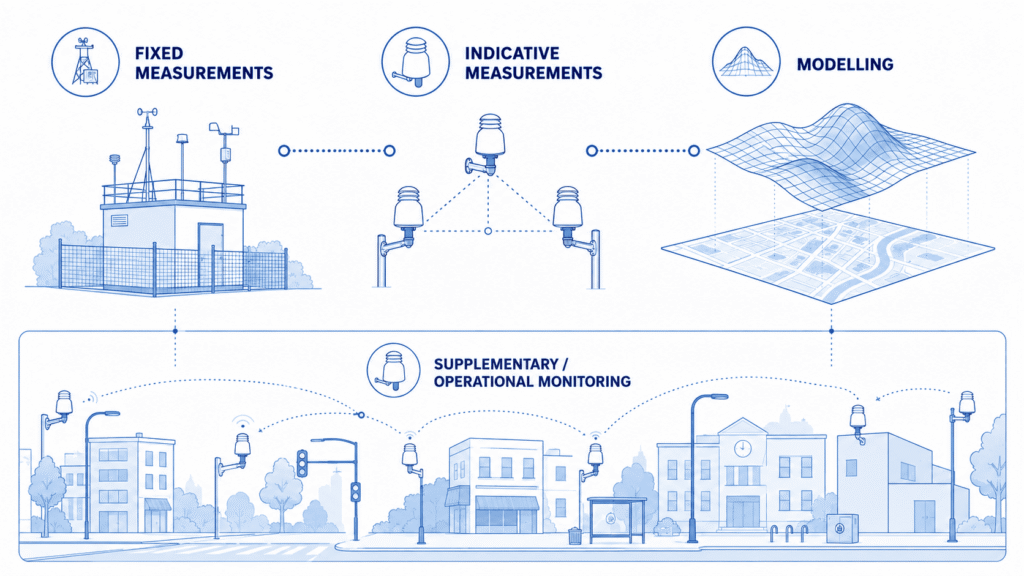
In the European framework, Directive (EU) 2024/2881 distinguishes fixed measurements, indicative measurements, modelling and other assessment methods. A sensor technology does not become “indicative” or regulatory simply because it is an OPC, electrochemical cell or another technology type. Suitability depends on the performance of the complete measurement system, the pollutant, the assessment purpose and the applicable data-quality requirements. Continuous sensor-based monitoring should therefore be described according to the role it has actually been validated to perform.
How to choose the right air quality sensor technology
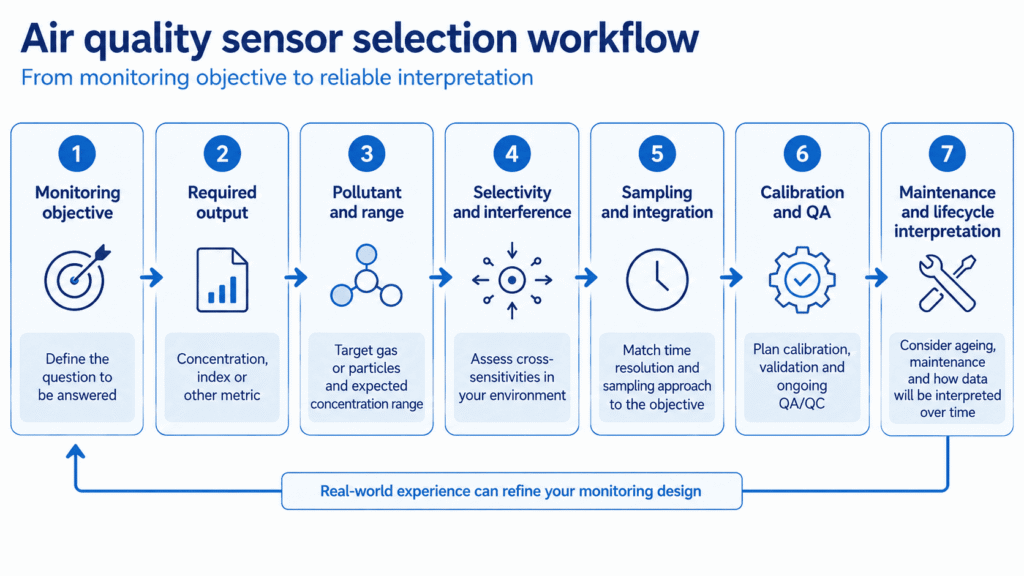
A useful selection process starts from the information required, not from the longest sensor list. The following sequence keeps the measurement objective connected to the sensing principle:
- Define the decision. Is the project investigating short events, spatial differences, long-term trends, process changes, research questions or a formal assessment requirement?
- Define the required output. Do you need PM mass estimates, particle-size information, a target-gas concentration, a broad VOC response, a processed air-quality index, or a model-dependent gas estimate?
- Define the pollutant and concentration range. Expected ambient levels, event peaks and required sensitivity can change which sensor family or model is appropriate.
- Check selectivity and interferences. Identify likely cross-sensitive gases, aerosol types, humidity conditions and other environmental factors that can alter the response.
- Check sampling and installation constraints. Inlet design, airflow, mounting position, power, communications and exposure conditions can influence the measurement system.
- Define calibration and QA/QC. Decide how factory calibration, field collocation, zero/span checks, reference comparisons, data screening and uncertainty will be handled for the intended use.
- Plan maintenance and lifecycle interpretation. Account for verification and recalibration intervals, service life, replacement, cleaning, lamp or optical maintenance where relevant, drift management and the ongoing QA needed to keep data comparable. Make sure dashboards and reports preserve the meaning and limitations of each output.
This process often leads to a multi-sensor configuration rather than one “best” technology. Particulate matter, target gases, CO2 and broad VOC indicators may each require a different sensing principle, while meteorological measurements provide context for interpretation.
How Aernode combines different sensing technologies
Aernode uses a modular sensing architecture so different measurement principles can be combined within one outdoor monitoring system without treating them as interchangeable. In current configurations, the Core Sensor Board can host OPC-based particulate matter measurement, NDIR carbon dioxide measurement and a MOX-based T.VOC Index, alongside environmental parameters. The optional Sensor Deck extends the station with electrochemical gas channels and PID-based VOC measurement. MOX technology also exists for gases beyond VOCs, including implementations targeting NO2 and O3; current Aernode compound-specific ambient gas channels such as NO2 and O3 use electrochemical sensing, while MOX is used for the broad T.VOC Index.
The practical value of that architecture is configuration by monitoring objective. Technology selection considers the target pollutant, required concentration range, selectivity, environmental response, calibration behaviour, drift, operating stability, maintenance burden and lifecycle comparability of the data. A lower component purchase price does not automatically produce a lower total cost of measurement quality. The Aernode Sensor Kits page sets out the current replaceable sensing assemblies, while the Aernode Air Quality Monitor page shows how those sensing layers sit within the complete outdoor station.
For research and field studies, the same distinction is useful methodologically: a project can select the parameters and sensor technologies that answer the research question, then define collocation, validation, metadata and uncertainty procedures appropriate to the study. Aernode supports continuous supplementary monitoring and, where the applicable pollutant, measurement method, achieved data quality and assessment framework support it, indicative monitoring. The selected sensing technology does not replace reference or regulatory measurement methods where those are required.
The key decision is the information the project needs
OPC, electrochemical, NDIR, PID and MOX sensors are not competing versions of one universal measurement principle. They solve different problems. OPCs turn optical particle measurements into continuous particulate information. Electrochemical cells convert gas reactions into target-gas signals. NDIR uses selective infrared absorption. PIDs provide a broad response to ionizable compounds. MOX sensors use a chemiresistive metal-oxide response that may support broad VOC / air-quality indexes or model-dependent target-gas outputs, depending on the implementation.
A strong technology choice considers not only sensor-element price and nominal sensitivity, but the measurement principle, required output, field performance, QA and the complete cost of maintaining comparable, interpretable data over the required deployment life. A strong monitoring design therefore starts by defining the information that must support the decision, then checks whether the complete instrument and calibration approach can sustain that evidence role in field conditions. In practical terms, technology selection = measurement principle + required output + field performance + QA + lifecycle measurement cost. That is more useful than asking which sensor technology is “best” in the abstract.
Technical References
1. Directive (EU) 2024/2881 on ambient air quality and cleaner air for Europe. European Parliament and Council.
2. Guidance on low-cost air quality sensor deployment for non-experts based on the AirSensEUR experience. European Commission Joint Research Centre (JRC), 2022.
3. Air Sensor Performance Targets and Testing Protocols. U.S. Environmental Protection Agency.
4. Enhanced Air Sensor Guidebook. U.S. Environmental Protection Agency, 2022.
5. Measuring air pollution with low-cost sensors. European Commission Joint Research Centre (JRC), 2017.
6. Practical Use of Metal Oxide Semiconductor Gas Sensors for Measuring Nitrogen Dioxide and Ozone in Urban Environments. Peterson et al., Sensors, 2017.