Industrial odour problems are often intermittent. A source test can characterise an emission under defined conditions, and field inspection can document ambient odour exposure or a recognisable plume, but an odour event may have disappeared before it is investigated. Process conditions can also change between periodic assessments, leaving an important question unanswered: what happened in the hours, days or weeks between them?
Continuous chemical monitoring can fill part of that temporal gap. Its distinctive value is time continuity – detecting short changes, showing duration and recurrence, comparing locations, relating signals to process state, supporting an alert and investigation workflow and preserving an environmental record between formal assessment events. The key is to define what the measured parameter represents. Treat a measured gas as an indicator first. Treat it as an odour surrogate only when the relationship has actually been demonstrated for the process and intended use.
Industrial odour monitoring is not one measurement
Different methods answer different questions. EN 13725:2022 defines dynamic olfactometry for determining the odour concentration of a gaseous source sample and the odour emission rate from stationary sources. It is a source-sampling method; it does not describe continuous ambient exposure.
EN 16841-1:2016 uses field inspection by the grid method to characterise odour exposure across an assessment area over an extended survey period. EN 16841-2:2016 uses the plume method to determine the extent of recognisable odour from a specific source under defined meteorological conditions. Neither field-inspection method measures the same quantity as EN 13725 source dynamic olfactometry.
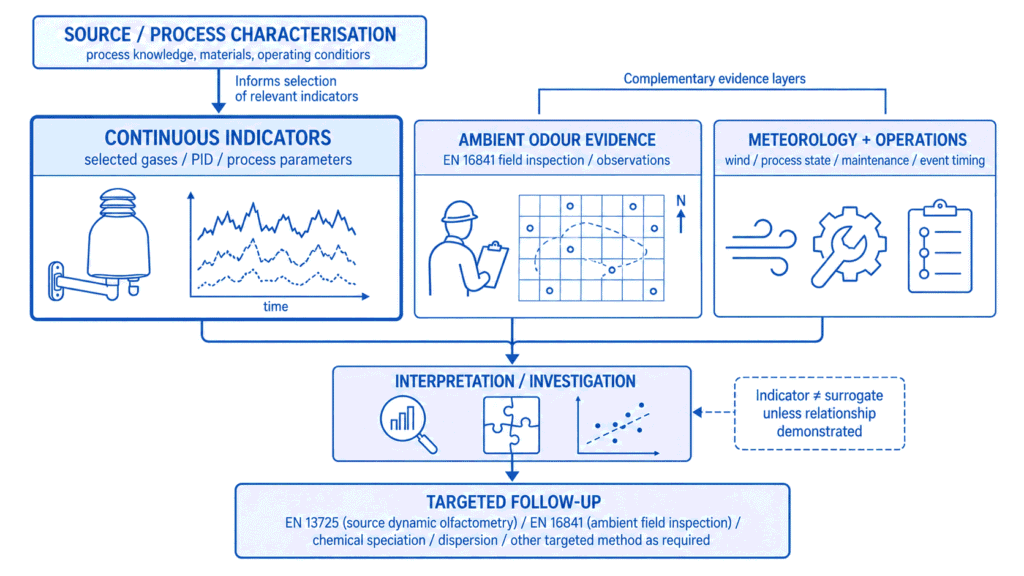
Continuous chemical or instrumental monitoring adds another evidence layer: time-resolved measurements of selected gases or parameters. Human observations and complaint records identify when and where odour was perceived. Meteorology adds transport context. Process and maintenance records show what the plant was doing at the same time. Used together, these layers can turn an intermittent complaint into a testable investigation rather than a retrospective guess.
| Evidence layer | What it answers | What it does not answer by itself |
|---|---|---|
| EN 13725 source dynamic olfactometry | What is the odour concentration of a source sample, and what is the odour emission rate under the sampled conditions? | Ambient exposure over time, plume extent or the timing of an off-site event. |
| EN 16841-1 grid field inspection | How frequently is recognisable odour observed across an assessment area over the survey period? | Source-sample odour concentration or continuous chemical time series. |
| EN 16841-2 plume field inspection | How far does a recognisable odour plume extend from a specific source under defined meteorological conditions? | Long-term exposure frequency or source-sample odour concentration. |
| Continuous chemical / instrumental indicators | When did selected chemical or process-related signals change, for how long, and how often? | Perceived odour or a defensible odour surrogate unless the relationship has been demonstrated. |
| Human observations / complaints | When and where was odour perceived, and how was the event experienced? | Chemical identity, concentration or source on their own. |
| Meteorology | Was the wind and dispersion context consistent with transport between relevant site areas and receptors? | Source attribution on wind direction alone. |
| Process / maintenance records | Which operating state, loading, maintenance or upset condition coincided with the event window? | Off-site odour impact without supporting environmental evidence. |
An indicator is not automatically an odour surrogate
A continuously measured parameter can be useful before it qualifies as an odour surrogate. For practical purposes in this article, an indicator can be understood as a chemical or process-related measurement with a technically plausible relationship to a source, operating state or emission event. It can help detect changes, compare event timing and focus investigation even when it does not represent the odorous mixture as a whole.
A surrogate is a stronger claim. It means the measured parameter represents the relevant odorous emission well enough for a defined purpose. That relationship needs to be characterised and demonstrated for the application rather than assumed from the fact that the gas can smell.
For permitted activities in England, current Environment Agency guidance on instrument surrogate monitoring says surrogate monitoring requires a relationship between odour concentration and the measured parameter. Its appropriate-measures guidance also says surrogate chemicals or parameters may be used to confirm ongoing control performance where processes and emissions are well characterised, the method is sufficiently accurate and the results have been shown to represent the odorous emissions effectively. Those are England-specific regulatory statements, but the technical principle is transferable: the stronger the claim, the stronger the evidence needed to support the relationship.
Before treating an indicator as a surrogate, the evidence should be strong enough for the intended decision across the relevant:
- source or emission mixture;
- operating conditions and process states;
- concentration range of interest;
- monitoring method and field conditions;
- decision being supported – for example alerting, control review, event investigation or escalation to another method.
Why time continuity changes the evidence
Catch intermittent events before they disappear
Short releases, changing loads, cleaning operations, transfers, maintenance events or temporary abatement problems may not be present when a periodic visit or source test takes place. A continuous time series can preserve the onset, duration and recovery of a candidate indicator, allowing the event to be reviewed after the fact rather than relying only on memory or a complaint timestamp.
Connect environmental signals to process state and recurrence
One event may be ambiguous. Repeated events that occur under similar operating conditions are more informative. Continuous monitoring allows environmental teams to compare indicator behaviour with production state, loading, start-up or shutdown, maintenance and other operational records. Recurrence can help distinguish a one-off anomaly from a pattern worth targeted investigation.
Compare locations and build a historical environmental record
Where several monitoring points are justified, time-aligned data can show whether a change was local to one node or appeared across a wider part of the site. Meteorological context can then be used to test whether the spatial pattern is consistent with transport from relevant source areas. Over time, the network also creates a historical record that supports before-and-after comparison when operating practices or controls change.
Review controls between periodic assessments
Periodic formal assessments remain important where required, but they are snapshots. Environment Agency guidance for permitted activities in England explicitly notes that periodic emissions assessments do not show whether abatement continues to work as intended between sampling events and therefore calls for frequent or, where practical, continuous monitoring of relevant secondary parameters. The requirement is jurisdiction-specific; the broader technical value is that continuous parameters can reveal drift or abnormal operation between formal checks and help prioritise targeted testing, maintenance or field assessment.
Choose indicators from the process chemistry, not from an “odour sensor” checklist
The starting point is source and process knowledge. What materials are handled? Which reactions, degradation pathways, storage conditions or abatement stages could generate odorous emissions? Which compounds or process parameters are expected to change when the relevant event occurs? Only then should a candidate indicator be matched to a measurement method and expected concentration range.
H2S. Potentially relevant to sulphide-bearing or anaerobic processes where hydrogen sulphide is known to be part of the emission profile. It is not a universal proxy for total odour.
NH3. Potentially relevant to specific chemical, refrigeration, waste or agro-industrial processes where ammonia release is technically plausible.
VOC / PID response. Potentially useful where changes in volatile organic emissions track the relevant process or event. A PID response is an instrumental response to ionisable VOCs under the selected configuration; it should not be interpreted as total odour or as a universal measure of total VOC mass.
The practical sequence is process/source knowledge -> candidate indicator -> measurement suitability -> demonstrated relationship where surrogate use is intended. There is no universal pollutant package that answers every industrial odour problem.
When is continuous indicator monitoring worth using?
| Question | What needs to be true |
|---|---|
| Is there a plausible measurable indicator? | Source and process chemistry are understood well enough to identify a parameter related to the relevant emission or operating state. |
| Can it be measured continuously at the relevant levels? | The method is fit for the expected concentration range, environmental conditions, response time and field deployment. |
| Does timing matter? | Intermittent, changing or short events create a real information gap that periodic assessment alone cannot resolve. |
| Can the signal be interpreted? | Meteorology, process records, spatial comparison and relevant observations are available to provide context. |
| Is surrogate use intended? | The relationship with the relevant odorous emissions has been demonstrated sufficiently for that specific use and operating conditions. |
| What decision will follow? | The next action is defined: alert, investigation, control review, before/after comparison or escalation to a formal or more specific method. |
What continuous monitoring cannot establish by itself
The value of continuous data depends on keeping its evidential role clear. Current Environment Agency guidance on ambient odour surrogates makes the same core distinction for permitted activities in England: instruments can provide near-continuous patterns of chemicals or other indicators, but they do not measure human-perceived odour directly. A stable surrogate relationship requires detailed emission characterisation.
- It does not automatically measure perceived odour, odour intensity or offensiveness.
- It does not convert every gas or PID reading into an odour concentration.
- It does not prove source attribution, nuisance or regulatory non-compliance from a single signal or one monitoring point.
- It does not replace EN 13725, EN 16841 field inspection or another formal method when that method is required by the applicable permit, BAT conclusion, assessment framework or project specification.
From indicator signal to investigation
- Characterise the source and process. Identify plausible odour-generating operations, materials, emission mixtures and abatement stages.
- Select candidate indicators. Choose gases or process parameters because they are technically relevant to the suspected source, not because they appear on a generic sensor list.
- Confirm measurement suitability. Check expected concentration range, response time, environmental influences, cross-sensitivities, siting and the data quality needed for the intended use.
- Collect time-resolved data. Preserve event onset, duration, recovery and recurrence rather than relying only on periodic snapshots.
- Add meteorology and spatial comparison. Use wind information and, where justified, multiple nodes to test whether the observed pattern is consistent with site geometry and transport.
- Align process and complaint timelines. Compare measurements with operations, maintenance, abnormal conditions and observations of perceived odour.
- Test recurring patterns. Look for consistent relationships across repeated events and operating states before increasing the strength of the interpretation.
- Escalate when needed. Use dynamic olfactometry, EN 16841 field inspection, chemical speciation, dispersion analysis or another targeted method when the continuous indicator cannot answer the remaining question.
Sector-specific EU BAT conclusions use similar odour-management structures in several industrial activities, but applicability remains sector-specific. Commission Implementing Decision (EU) 2016/902 for common waste-water and waste-gas treatment/management systems in the chemical sector links odour monitoring with incident response, source identification, exposure assessment and prevention/reduction. The 2024 smitheries and foundries BAT conclusions use a comparable management-plan structure and, where odour nuisance is expected or substantiated, explicitly cite EN 13725 and EN 16841-1/-2 as examples of periodic odour-monitoring methods. These examples illustrate the wider architecture; they do not create a universal EU industrial odour-monitoring obligation.
How Aernode fits the continuous indicator layer
Aernode Air Quality Monitor can provide continuous field measurements across project-selected pollutants and environmental parameters. Sensor Kits allow gas configurations to be selected around source chemistry and the monitoring objective, while meteorological accessories can add wind and weather context for interpreting time-resolved changes.
Aernode Cloud supports network supervision and continuous time-series storage, and Reporting Tools support alerts, historical review, event analysis, cross-parameter comparison and reporting. In this role, Aernode supports the continuous indicator layer of an industrial odour-monitoring programme. Whether a measured parameter can be treated as a defensible odour surrogate depends on source characterisation and evidence established for the specific application.
The practical conclusion
Continuous chemical monitoring does not need to measure perceived odour directly to be valuable. Its strongest contribution is temporal: it can preserve intermittent events, reveal recurrence, connect environmental changes with process state, compare locations and show what happens between periodic formal assessments.
The technical discipline is to match the strength of the claim to the strength of the evidence. Start with a process-relevant indicator. Confirm that the method can measure it reliably under field conditions. Add meteorology, spatial and operational context. Treat the parameter as an odour surrogate only if that relationship has been demonstrated well enough for the intended use. Used this way, continuous monitoring becomes a defensible investigation, screening and control-review layer inside a wider industrial odour-management system.
Technical References
4. Environment Agency – Odour management: comply with your environmental permit (published 3 December 2025): Appropriate measures for odour management; Assessing odorous emissions; Assessing the impact of odour. England-specific regulator guidance used for transferable technical principles.
5. Commission Implementing Decision (EU) 2016/902 – BAT conclusions for common waste water and waste gas treatment/management systems in the chemical sector. 6. Commission Implementing Decision (EU) 2024/2974 – BAT conclusions for the smitheries and foundries industry.