Why livestock air quality changes across place and time
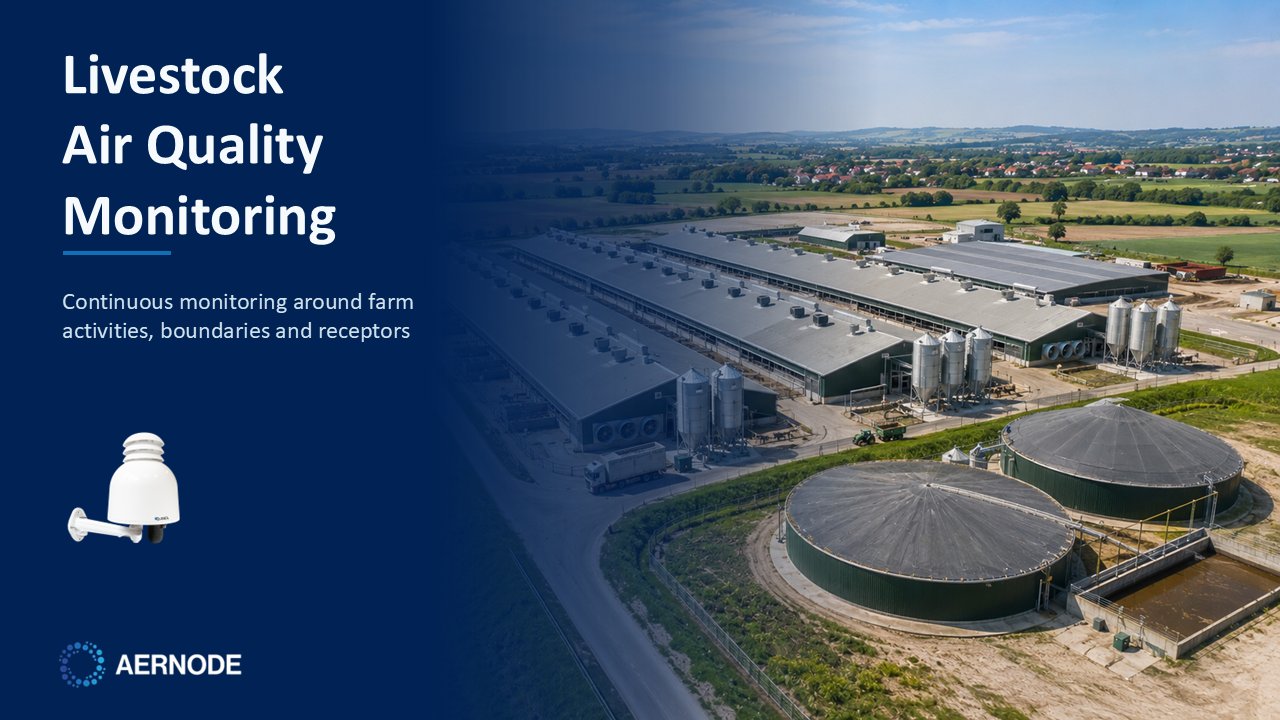
An intensive livestock farm contains several environmental activity zones rather than one uniform source. Outdoor conditions can change with animal housing and production cycles, ventilation, manure or slurry handling and storage, feed and bedding activities, cleaning, vehicle movements and weather. A measurement collected periodically – or only after a complaint – may miss the conditions that existed when an event occurred.
Those activity zones do not remain in fixed environmental roles: ventilation, farm operations and meteorology can change which areas influence a boundary or receptor at a given time. This Guide focuses on outdoor monitoring around livestock activity areas, site boundaries and relevant receptors for poultry and pig operations and, where relevant, dairy or cattle facilities with concentrated housing and manure-management systems. It does not cover indoor animal-welfare or occupational monitoring, greenhouse-gas accounting, direct whole-farm emission quantification, direct odour-concentration measurement, automatic source attribution or permit-specific compliance methods.
Why add a continuous environmental monitoring layer?
The strongest reason to add continuous monitoring is not to collect the largest possible dataset. It is to create a documented environmental record that can be revisited when conditions change or a question arises.
- Maintain continuous environmental oversight across relevant farm areas rather than relying only on occasional snapshots.
- Identify recurring concentration or particulate patterns that appear at particular times, locations or operating conditions.
- Add time-resolved evidence when odour or other local environmental concerns are reported.
- Use project-specific alerts to flag unusual monitored patterns for review.
- Compare environmental conditions across livestock buildings, manure areas, boundaries and receptor directions.
- Evaluate measurements before and after a defined operational or mitigation change.
- Maintain structured records that support internal environmental management and evidence-based communication with authorities, municipalities and neighbouring communities.
Where continuous monitoring is voluntary, these uses should be understood as an additional environmental-management layer. The data do not by themselves establish regulatory compliance, prove the absence of impact, identify a source automatically or guarantee stakeholder acceptance.
Within the formal scope of the EU BAT Decision for intensive poultry and pig installations, BAT 12 treats odour management as a documented process only where odour nuisance at sensitive receptors is expected and/or substantiated: the plan includes monitoring, response procedures, prevention or reduction actions, and review of historical incidents and remedies. A supplementary continuous environmental network does not replace the formal odour-monitoring methods referenced in BAT 26, but it can provide additional time-resolved evidence for investigation and follow-up.
Start with the question the network needs to answer
Monitoring objectives should be defined before pollutants, node count or hardware are selected. The same farm may need different measurement roles for day-to-day oversight, boundary comparison, event investigation or a before-and-after operational review.
| Monitoring objective | Question the network should help answer |
|---|---|
| Continuous environmental oversight | What changes over time across the farm areas that matter to environmental management? |
| Boundary / receptor context | Do recurring patterns differ between farm activity areas, boundaries, background locations and nearby receptor directions? |
| Odour / environmental event investigation | What measurements, wind conditions and farm activities were present during the reported event window? |
| Operational alerts | When should an unusual monitored pattern trigger a data-quality check and operational review? |
| Mitigation / operational evaluation | Did measured environmental conditions change before, during and after a defined intervention? |
| Reporting / stakeholder communication | Can the operator maintain a structured historical environmental record with traceable measurements and follow-up? |
Different objectives can require different parameters, monitoring locations, time resolution, data-quality controls and follow-up workflows. A network designed for a receptor complaint, for example, may need a different spatial comparison than a network designed to review recurring dust conditions near feed handling.
What should an intensive livestock monitoring network measure?
There is no universal livestock sensor package. Parameter selection should follow the monitoring objective, livestock activities, likely environmental pathways, site layout and the concentration range the project needs to resolve.
| Parameter | What it can add | Typical farm context | Important limitation |
|---|---|---|---|
| NH3 – ammonia | Time-resolved gaseous indicator that can show temporal and spatial concentration patterns. | Livestock housing, ventilation outlets, manure handling and storage, boundary or receptor-oriented monitoring. | Ambient concentration at one point is not the total farm ammonia emission rate. |
| PM10 / PM2.5 – particulate matter | Continuous particle concentration data for dust and particulate episodes. | Feed and bedding activity, animal-house exhaust, animal activity, vehicle movements and boundary conditions. | PM measurements do not by themselves identify or quantify biological bioaerosols. |
| H2S – hydrogen sulphide | Additional gas context where anaerobic manure or slurry conditions are relevant. | Selected manure/slurry handling, storage or event-investigation contexts. | Site-specific indicator; not a universal livestock parameter and not a direct odour measurement. |
| VOC indicator / PID | A changing volatile signal that can add context during selected environmental or odour-related events. | Organic-material, manure-management or other site-specific volatile conditions. | Does not provide full VOC speciation and does not equal odour concentration. |
| Wind speed / direction | Essential transport context for comparing locations and interpreting changing source-to-receptor pathways. | Whole network, especially boundary and receptor-oriented monitoring. | Wind compatibility supports interpretation but does not prove source attribution. |
| Temperature / relative humidity | Environmental context for farm conditions and for interpreting sensor behaviour and data quality. | Across outdoor deployments and QA review. | Useful context, but not a substitute for pollutant or meteorological measurements needed by the objective. |
Particulate matter is a genuine livestock-air question rather than an optional add-on. A peer-reviewed Dutch livestock-housing study measured PM10 and PM2.5 across 36 poultry, pig and dairy farms and found substantial differences by housing system and animal category. That evidence supports treating PM as a distinct environmental parameter while keeping its interpretation separate from bioaerosol identification.
Why ammonia remains an important livestock parameter
Ammonia remains central because agriculture is the principal source of NH3 emissions in the EU. The European Environment Agency identifies livestock and animal production, manure handling and storage, livestock housing, and manure or slurry application among the primary sources. Around a farm, continuous ambient NH3 measurements can reveal when and where concentration patterns change, especially when they are reviewed with ventilation, weather and farm activity.
Its environmental significance also extends beyond the immediate farm boundary: atmospheric NH3 contributes to the formation of ammonium nitrate and ammonium sulphate, important components of secondary particulate matter, and to wider nitrogen-related eutrophication and acidification impacts. This does not mean that a local PM monitor can distinguish direct livestock dust from secondary particulate formed in the atmosphere; those remain separate measurement and attribution questions.
The boundary is equally important: an ambient concentration measured at a node is shaped by source strength, distance, ventilation, wind, atmospheric mixing and local geometry. It should not be treated as a direct measurement of whole-farm ammonia emissions.
The formal poultry and pig BAT framework also separates the environmental questions
Within its formal scope for intensive rearing of poultry or pigs, the EU BAT conclusions for intensive rearing of poultry or pigs treat air-emission management as multi-dimensional. BAT 25 addresses ammonia emissions; BAT 26 addresses odour emissions where its applicability condition is met; BAT 27 addresses dust emissions; and BAT 28 covers ammonia, dust and/or odour emissions from animal houses equipped with air-cleaning systems. BAT 29 separately tracks relevant process parameters.
The practical point is not that every livestock farm must apply those BAT monitoring methods. It is that ammonia, dust, odour and operating context are distinct environmental questions. The Decision applies to defined intensive poultry and pig installations and must not be generalized to cattle or dairy farms, smaller operations or every livestock facility.
Design the network around farm activities, boundaries and receptors
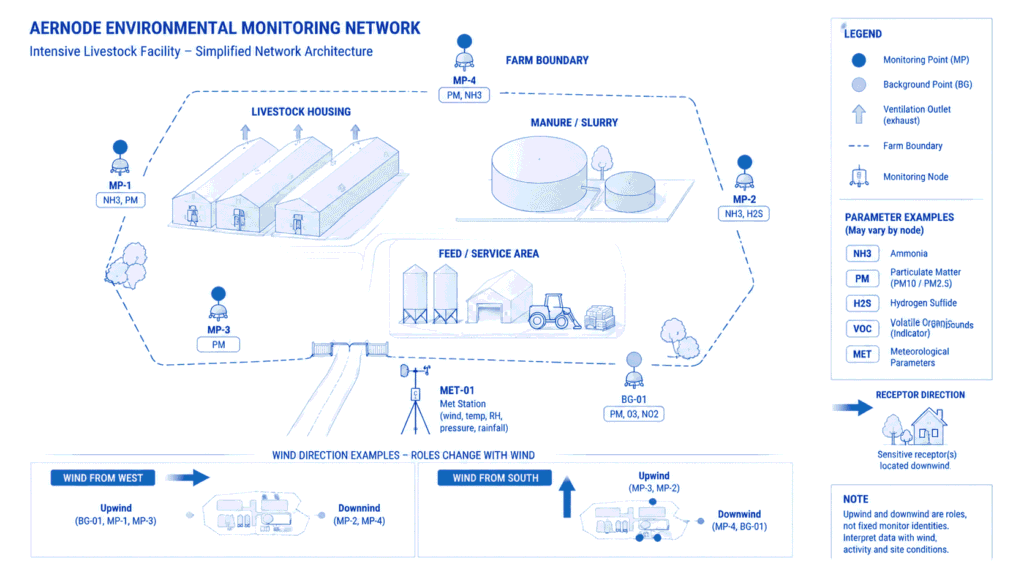
A network should represent the environmental questions around the site rather than apply equal fence spacing by default. Useful monitoring roles may include:
- livestock buildings and ventilation outlets, where outdoor measurements can be compared with housing or ventilation conditions;
- manure or slurry handling and storage areas, where selected gases or changing conditions may be most relevant;
- feed and bedding activity areas when dust or particulate episodes are part of the objective;
- a farm-boundary location chosen for a defined sector or neighbouring interface;
- a background or comparison location that helps distinguish local changes from wider conditions; and
- a receptor-oriented location where a nearby home, community area or other relevant receptor justifies direct context.
The number of nodes follows the questions, site geometry and available comparison roles. One farm may need only a small targeted layout; another may need several distributed points to distinguish activity areas, boundaries and receptors.
Treat upwind and downwind as changing roles
Wind direction changes, so ‘upwind’ and ‘downwind’ should not be treated as permanent monitor identities. A node may be downwind of a livestock building during one period and crosswind or upwind later. Wind speed and direction should therefore be part of the network architecture, with meteorological and deployment accessories selected when they add the context needed by the monitoring objective.
Connect farm activities to the environmental record
Outdoor measurements become more interpretable when they are time-aligned with a concise activity timeline. The aim is not to reproduce the full farm production database. It is to record the activities most likely to change the environmental picture during the periods the network is expected to explain.
- ventilation changes or animal-house operating changes;
- manure or slurry removal, transfer, agitation, treatment or storage operations;
- feed and bedding handling where material to the monitoring objective;
- cleaning operations;
- relevant vehicle movements or traffic peaks;
- livestock or production-cycle changes when they materially alter ventilation or activity;
- maintenance or air-treatment-system changes; and
- meteorological conditions for the same time window.
A useful research example is AFBI Hillsborough high-resolution ammonia monitoring in Northern Ireland. The programme measures ammonia and weather at high time resolution and examines relationships between measured concentrations, farm activities, air temperature, wind speed and direction, and rainfall. Its value here is methodological rather than regulatory: the same time alignment makes an outdoor environmental record easier to interpret later.
From continuous monitoring to environmental action
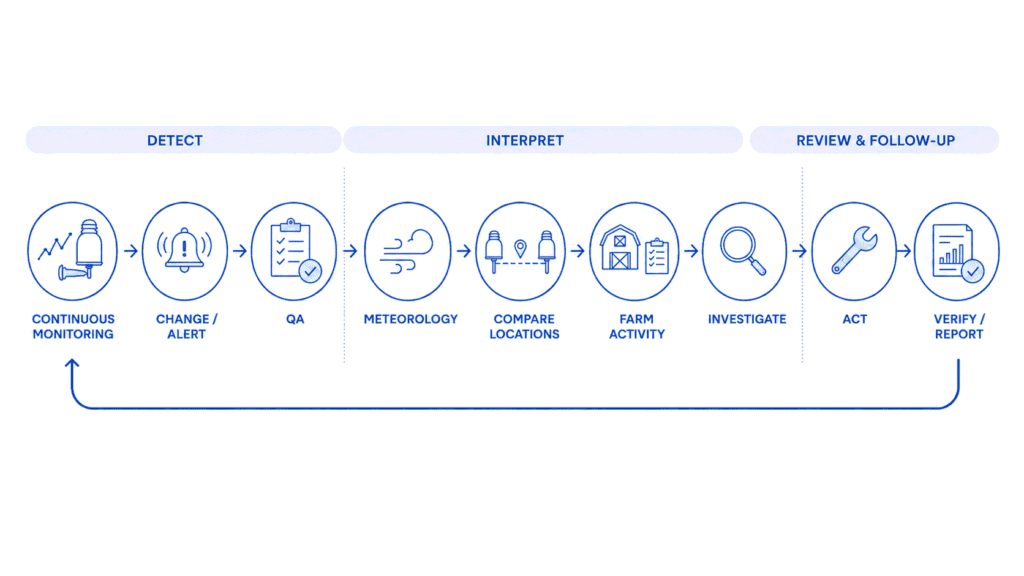
A continuous network becomes operationally useful when a change in the data leads to a repeatable review process rather than an automatic conclusion.
- Continuous measurements – maintain synchronized time-series records across the relevant nodes and parameters.
- Change / alert – flag a project-specific pattern, threshold, rate of change or cross-location difference for review.
- Data-quality check – confirm device status, completeness, maintenance state and whether the signal is technically credible.
- Wind / meteorology – review wind direction, wind speed, temperature, humidity and other relevant conditions.
- Compare monitoring locations – look for spatial agreement, contrast or a recurring boundary pattern.
- Review farm activity – compare the event window with ventilation, manure, feed/bedding, cleaning, traffic or other logged operations.
- Investigate – combine the available evidence and decide whether field inspection or additional information is needed.
- Action where justified – make an operational or environmental response only when the evidence supports it.
- Verify / document – compare the following period, record what changed and preserve the outcome for reporting or future event review.
This workflow can support odour-event review, unusual NH3 patterns, PM episodes, recurring boundary conditions and mitigation follow-up. Alerts should be treated as project-specific investigation triggers. They are not universal ammonia alarm levels, universal odour thresholds or automatic regulatory exceedances, and they do not establish source attribution.
Use monitoring to review operational and mitigation changes
A consistent network can support before, during and after comparisons when the operator changes ventilation settings, manure-removal practices, manure or slurry storage arrangements, feed or bedding management, traffic patterns, or an air-treatment or cleaning system where one is present.
The useful question is whether the monitored environmental conditions changed in a consistent and interpretable way. Meteorology, livestock numbers, production cycle and other simultaneous operating changes still have to be considered. Continuous measurements can strengthen operational review, but they do not by themselves prove causal effectiveness or certify regulatory performance.
Treat the data layer as part of the monitoring system
A field instrument is only one part of a continuous programme. Useful environmental management depends on keeping the measurement and context layers connected over time:
- field measurement;
- network supervision;
- meteorology;
- farm activity and event records;
- project-specific alerts;
- historical data;
- analysis; and
- reporting.
When an event is reviewed weeks or months later, the analyst should be able to reconstruct timestamps, device status, data completeness, calibration or maintenance history, farm events and meteorological conditions for the same period. Network supervision and historical data make that record operationally traceable, while alerts, analysis and reporting can turn the same record into review workflows and structured outputs.
Measurement quality determines what the network can support
Data quality sets the boundary of every interpretation. A European Commission JRC review of ammonia and other emerging air-pollutant monitoring discusses measurement methodologies, monitoring data availability and the resources needed for suitable devices and networks. For an outdoor multi-parameter livestock programme, the practical QA questions are broader than any one gas sensor.
- Is the expected measurement range appropriate for the concentrations and event patterns of interest?
- Is the sensing configuration suitable for the selected parameters and environmental conditions?
- Are known cross-sensitivities and temperature or relative-humidity effects understood?
- Is there a defined calibration, verification and drift-check strategy?
- Are maintenance and sensor-lifecycle events recorded so that affected periods can be identified?
- Are timestamps synchronized and data-completeness rules defined?
- Are multiple nodes treated consistently enough for spatial comparison?
- Can the project distinguish missing or invalid data from genuinely low environmental concentrations?
A network with more nodes is not stronger if those nodes cannot be compared reliably. QA should therefore be designed at fleet level as well as instrument level.
Keep continuous monitoring and formal measurement roles distinct
Operational outdoor monitoring can add high-frequency, multi-location context, but some environmental questions require different or additional methods.
| Question | Continuous outdoor network can support | Separate / formal method may be required |
| Ambient concentration patterns | Time-resolved comparison across selected outdoor locations. | Reference or permit-defined ambient methods where formally required. |
| Whole-farm NH3 emission rate | Context on local ambient concentrations and changing conditions. | Emission factors, mass balance, concentration plus ventilation, modelling or other competent-authority / BAT methods. |
| Odour concentration | Context from selected gas/VOC indicators, meteorology and event timing. | Standardized odour measurement such as dynamic olfactometry when the formal question requires it. |
| Dust emissions from animal houses | Outdoor PM trends around relevant locations. | Formal dust-emission methods where required by BAT, permit or study design. |
| Occupational / indoor animal-house air | Not the objective of this outdoor network. | Dedicated indoor/exposure monitoring and relevant assessment criteria. |
| Source attribution | Multiple lines of evidence that support investigation. | Dedicated source-apportionment, dispersion or other attribution studies when causal proof is required. |
This separation protects the practical value of continuous monitoring: the network can be very useful without being presented as a substitute for every formal emission, odour, dust, exposure or permit-specific measurement.
How Aernode supports the complete monitoring workflow
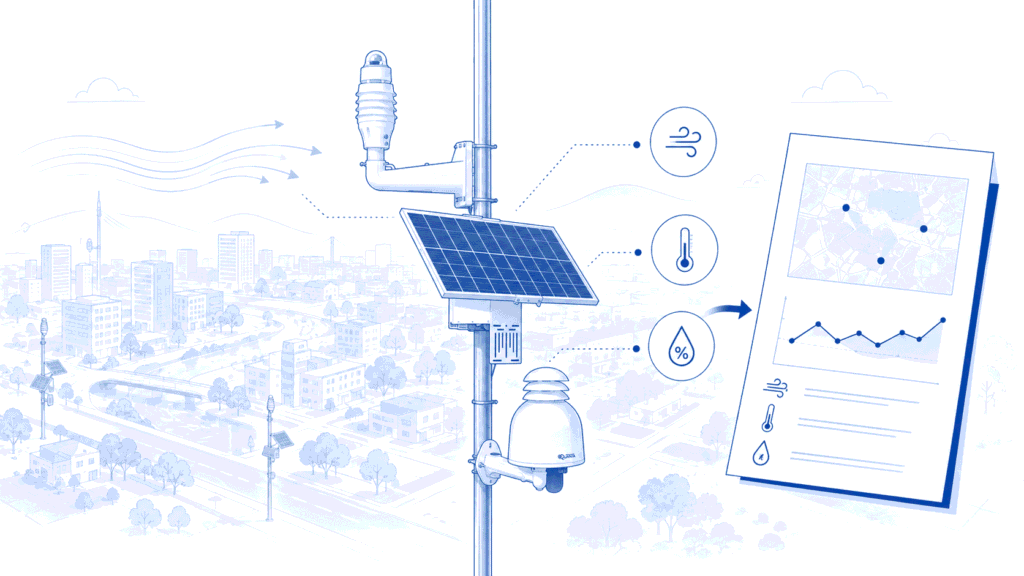
The Aernode application for air quality monitoring for intensive farming is built around the same workflow: define the environmental question, configure distributed outdoor measurement, add meteorological context, preserve historical data and use the record for operational review and reporting.
At field level, the Aernode Air Quality Monitor supports distributed outdoor monitoring with configurable particulate, gas and environmental sensing. Aernode Sensor Kits allow the sensing configuration to be selected for the project rather than treating NH3, PM, H2S or VOC indicators as a universal livestock package.
At data level, Aernode Cloud provides network supervision, structured time-series storage and historical data continuity. Aernode Reporting Tools add dashboards, event review, alerts and reporting outputs. Where wind or other deployment context is required, Aernode Accessories include meteorological sensing and field-deployment options.
This is a supplementary environmental monitoring architecture. Its role is to create a continuous local record around relevant farm activities, boundaries and receptors; formal permit or regulatory monitoring remains governed by the applicable method, scope and competent-authority requirements.
Build a continuous environmental record around the farm
The value of continuous livestock monitoring does not come from measuring the largest number of pollutants or installing the largest number of nodes. It comes from aligning farm activity with relevant environmental parameters, purposeful monitoring locations, meteorology, data quality, investigation and documented follow-up.
When those elements remain connected, changing conditions can be observed, compared and reconstructed over time. The network becomes an activity-aware environmental observation system: not a single-sensor answer, but a persistent record that helps operators decide what deserves investigation, what changed after an intervention and what evidence should be retained for future review or reporting.
Technical References
1. European Environment Agency – Ammonia emissions from agriculture and other sources (indicator).
3. Agri-Food and Biosciences Institute – High Resolution Ammonia Monitoring at AFBI Hillsborough.