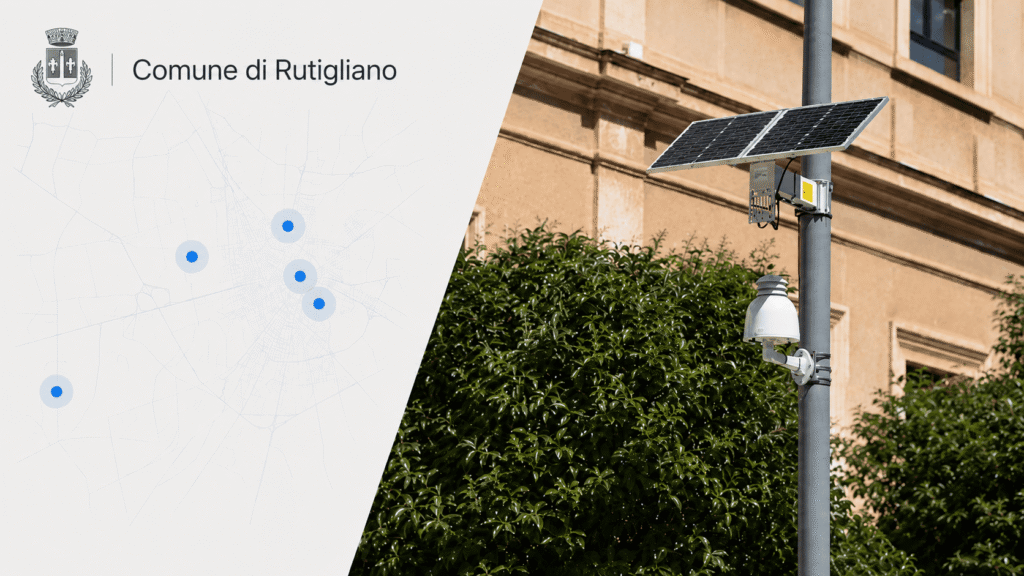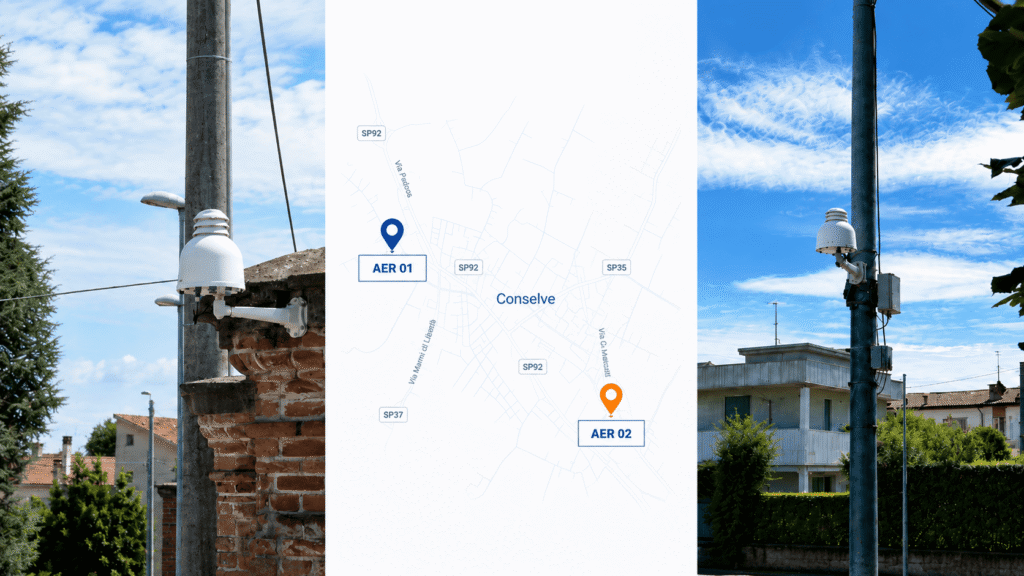

Continuous noise monitoring helps environmental teams see when measured noise conditions change, whether elevated periods recur, how periods or locations compare, and when investigation is warranted. A continuous noise sensor can support these operational applications when the objective, siting, reporting period and evidence role are defined clearly.
This Guide concerns outdoor environmental and community-noise observation. Occupational noise exposure, workplace dosimetry and formal acoustic assessment require different instruments, descriptors and methods. A noise sensor used for continuous operational monitoring should not be confused with a regulatory sound level meter or a standards-based acoustic assessment system.
For Aernode, the objective is persistent operational visibility rather than preservation of the complete acoustic signal for detailed specialist analysis. Continuous monitoring builds a historical record that helps teams identify recurring patterns, elevated or unusual periods, changes through time and differences between selected monitoring locations.
Where continuous environmental noise monitoring is useful
Continuous monitoring is most useful when a project needs persistent time context rather than an isolated observation. These applications show where a continuous noise history adds practical decision value.
Construction and demolition
Construction and demolition monitoring can track changing conditions around demolition, piling, earthworks, deliveries, generators and vehicle movements. A continuous record shows when measured noise conditions rise, how long elevated intervals last and whether events recur. Comparing phases or before/after conditions can identify time windows for review against activity logs. Coincidence supports investigation but does not prove causality or regulatory exceedance.
Industrial and site-perimeter monitoring
At an industrial boundary or receptor-relevant position, persistent monitoring can track production periods, maintenance windows and operating changes. The continuous record can reveal broader shifts in noise conditions and highlight elevated periods that deserve review. It can support before/after comparison around operational or mitigation measures, but it cannot identify which machine, process or external source produced an event without additional evidence.
Urban and traffic noise
In urban areas and traffic, continuous monitoring can reveal daily and weekly patterns, compare peak and off-peak periods, highlight recurring night-time conditions and support review around mobility or infrastructure changes. Selected locations can show spatial differences, but one point does not represent an entire neighbourhood or city. The Environmental Noise Directive uses Lden and Lnight for strategic assessment; Aernode noise-sensor data do not constitute those formal indicators and are not a substitute for the prescribed assessment method.
Ports, transport and infrastructure
Ports, logistics areas, road or rail corridors and transport terminals combine scheduled operations with intermittent events. Continuous noise data can compare operational windows, identify recurring elevated periods and select time windows for review alongside traffic or operational information. Multiple locations add spatial context, but timing and location differences are not automatic source attribution.
What continuous noise monitoring can reveal
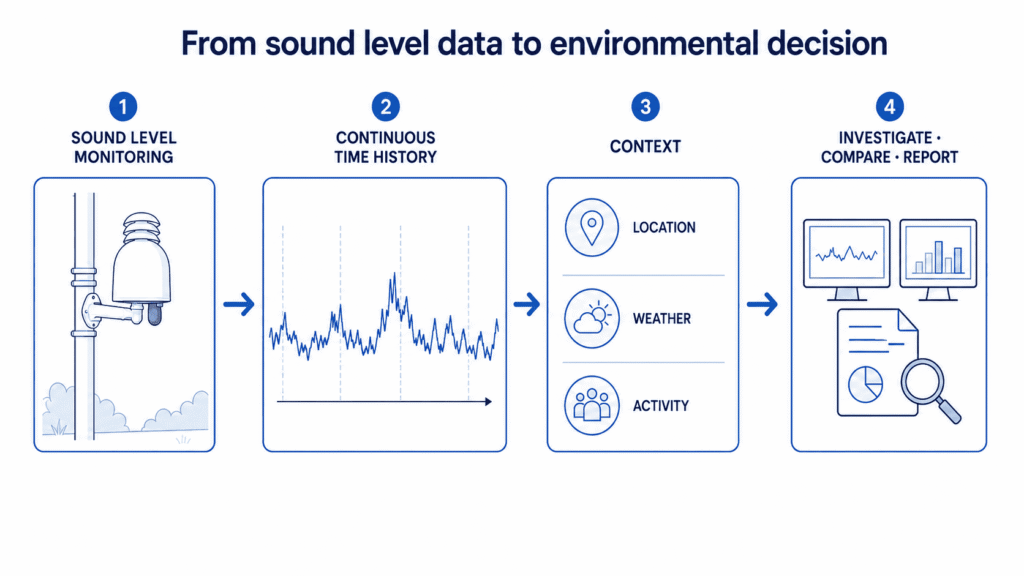
A continuous noise record moves a project beyond isolated observations. It allows teams to examine how measured noise conditions evolve through time, identify recurring patterns or unusual periods, compare operating phases and review whether similar behaviour appears at one or several monitoring locations. The strongest use is operational: identifying when something changed, how long it persisted, whether it recurs and where closer investigation is justified. The record becomes more useful when interpreted alongside location, weather, activity logs, traffic or other relevant context. It remains point-based evidence, so its value lies in trend, event and comparison visibility rather than automatic source attribution or formal compliance.
| Monitoring objective | Continuous monitoring can support | Where the limit begins |
|---|---|---|
| Track long-term patterns | Recurring daily, weekly or operational patterns and long-term change. | A prescribed formal indicator may require a specific assessment method. |
| Identify elevated periods | Unusual time windows, recurrence and investigation triggers. | Source identity or detailed acoustic character requires deeper investigation. |
| Compare operating periods | Before/after, day/night, active/inactive or project-phase comparison. | Causal attribution or formal proof of mitigation effectiveness needs a controlled assessment. |
| Compare locations | Location-specific histories and whether patterns appear at one or several points. | Point monitoring does not provide continuous acoustic knowledge between locations. |
| Trigger operational review | Threshold notifications or unusual time-series behaviour that flags periods needing attention. | A notification is not automatically a regulatory exceedance or official assessment result. |
| Review environmental context | Synchronized review with weather, activity, traffic or other parameters. | Co-occurrence does not establish a common source or causal relationship. |
One monitoring point or a distributed network?
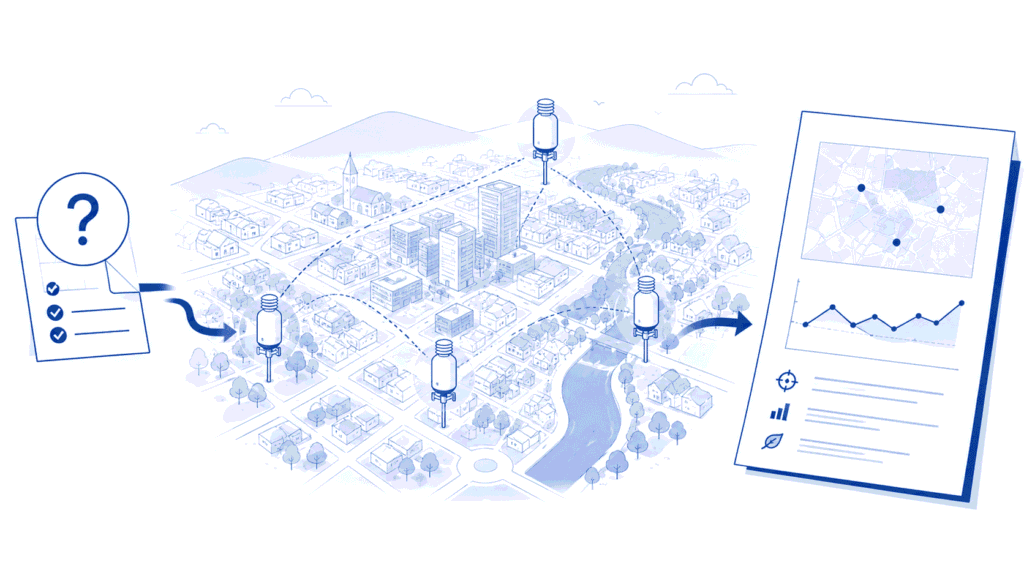
A single point provides a continuous history at one location. A distributed network of noise sensors adds spatial context by showing whether a pattern appears at one position, several positions or with different intensity. Its value is not simply more measurements, but comparable location-specific histories when clocks, settings, siting logic and processing are sufficiently consistent for the question. Spatial differences support investigation but do not identify a source, and points should be selected by monitoring role rather than equal spacing. Distributed point measurements add spatial context but do not automatically create a strategic noise map, propagation model or continuous knowledge between stations; strategic mapping under Directive 2002/49/EC is a different evidence layer.
Operational monitoring and specialist acoustic assessment answer different questions
Continuous operational monitoring is useful for persistent visibility of patterns, events and differences over time or between locations. A specialist acoustic assessment serves a different role when the project requires prescribed acoustic descriptors, detailed characterisation, formal method-specific evidence, source analysis or modelling. The approaches are complementary: continuous noise sensors help identify when and where closer investigation may be useful, while specialist assessment answers a more narrowly defined acoustic question using the instrumentation and method required for that purpose.
Environmental noise sensors vs Class 1 and Class 2 sound level meters
IEC 61672-1:2013 defines two performance classes for sound level meters: Class 1 and Class 2. These classes describe requirements for a sound level meter; an environmental noise sensor is not a third IEC class or a lower step in the same classification.
The distinction is both functional and metrological. Class 1 and Class 2 answer the question: what performance requirements does this sound level meter meet? An environmental noise sensor answers a different question: what monitoring function is the device designed to provide? For Aernode, that function is continuous, connected observation of noise-level patterns within a wider environmental monitoring network.
| Aspect | IEC 61672 Class 1 / Class 2 sound level meter | Environmental noise sensor |
|---|---|---|
| Classification | Formal instrument classes defined by IEC 61672. Class 1 generally has tighter acceptance limits than Class 2 for applicable tests. | The term does not imply an IEC class. Performance depends on the sensor design, manufacturer specifications and verification carried out for the product. |
| Primary role | Acoustic measurement with a defined instrument-performance framework; it may support formal assessment when the applicable method and jurisdiction allow or require it. | Continuous operational monitoring for trends, recurring events, screening, distributed comparison and operational alerts. |
| Continuous / connected operation | Can also be automatic, continuous, remote and connected. Connectivity is independent of IEC class. | Typically designed around continuous connected operation and integration with monitoring platforms. |
| Formal acoustic assessment | Use depends on the required class, descriptors, calibration, uncertainty treatment and complete assessment procedure. | Not a substitute for prescribed sound-level-meter measurements or a formal acoustic assessment. |
A standards-based sound level meter is not necessarily handheld or offline. Class 1 and Class 2 instruments can also be designed for automatic and continuous operation. The relevant distinction is therefore not “professional meter versus connected sensor”, but the evidence role, instrument-performance framework and measurement procedure required for the task.
When a project requires formal compliance assessment, legally defensible acoustic evidence, prescribed indicators or detailed acoustic characterisation, the required instrument and method should be specified separately according to the applicable standard, permit or specialist assessment procedure.
How to keep the operational time series interpretable
Useful long-term monitoring depends on siting, outdoor conditions, device verification, data continuity and consistent configuration being managed so changes in the time series remain interpretable. Where a project also requires formal acoustic assessment, measurement uncertainty belongs to that assessment framework and should not be inferred from the operational sensor output alone.
Know what your noise data represent
Noise values may all be expressed in decibels but do not necessarily represent the same acoustic quantity. The output from a continuous noise sensor should therefore be described by the value it actually stores and the reporting period used. If a project requires a prescribed descriptor, weighting, analysis function or reporting basis, define that requirement separately and use the relevant environmental-noise assessment method and instrumentation.
Choose a representative position
A monitoring point represents noise conditions at that position. Source and receptor distance, height, façade reflections, shielding, barriers and nearby structures can affect the result. Convenient placement is not automatically representative, and repeatability matters for comparisons.
Account for weather and outdoor conditions
Wind, rain and propagation conditions can affect both the environmental sound field and the sensor reading. Outdoor protection should be appropriate to the sensor, and weather-affected periods should be documented or flagged when they could materially change interpretation.
Control verification and configuration
Long-term operational value depends on knowing that the sensor remains in its intended configuration and on documenting maintenance, replacement and project-defined checks. These are operational quality controls, not IEC 61672 sound-level-meter calibration or periodic testing. Where standards-based calibration or periodic testing is required, it belongs to the specified sound level meter and assessment procedure.
Protect the time series
Long-term data remain useful only when timestamps, reporting periods, uptime, maintenance and configuration changes are traceable. Missing data should not be silently averaged away, and compared locations need sufficiently consistent clocks, settings and processing.
Choose the measurement approach from the evidence role
Start with the evidence role. For persistent trend and event visibility, a continuous noise sensor can be a practical operational tool when its output, range, siting and data continuity are appropriate to the question. For formal acoustic assessment, use the sound level meter class, descriptors, calibration, uncertainty treatment and procedure required by the governing method. An Aernode operational threshold is a trigger for review, not a regulatory exceedance.
| Use case | Operational noise-sensor role | What to verify / when to escalate |
|---|---|---|
| Trend / event visibility | Supports continuous pattern and event visibility. | Sensor output, reporting interval, range, outdoor setup and data completeness. |
| Distributed monitoring | Useful for location-specific histories and comparison across selected points. | Consistent clocks, settings and siting; spatial differences are not source proof. |
| Before / after comparison | Can support operational comparison when relevant conditions are controlled. | Comparable activity, weather, position, duration and data meaning. |
| Formal acoustic assessment | Not the intended evidence role of the Aernode noise sensor. | Use the instrument, descriptors, calibration, uncertainty treatment and method required by the governing procedure. |
| Contested / legal evidence | Not the intended evidence role of the Aernode noise sensor. | Specialist acoustic assessment and purpose-appropriate instrumentation are normally required. |
A specification checklist for continuous environmental noise monitoring
Before selecting or configuring continuous noise monitoring, define the evidence requirement first:
- What decision will the noise data support – operational review, trend tracking, public information, formal assessment or something else?
- What values does the sensor actually store, over what reporting period, and are those outputs sufficient for the operational question?
- Does the applicable standard, permit or local rule require a specific sound level meter class, acoustic descriptor or formal assessment method? If so, plan specialist instrumentation separately.
- What measurement range, noise floor and time resolution are needed for the expected environment?
- Does the project require frequency weighting, time weighting, integration, statistical levels or frequency analysis that must be provided and verified by the selected acoustic method?
- How will the outdoor sensor arrangement be protected, and how will weather-affected periods be documented or screened?
- Where should each monitoring point be located to represent the source, receptor, boundary or comparison the project actually cares about?
- What device checks, maintenance and configuration controls are needed to keep the operational time series consistent?
- How will timestamps, reporting periods, uptime, missing data, configuration changes and maintenance periods be documented?
- Will threshold notifications be operational triggers for investigation, or are they being incorrectly treated as regulatory exceedances?
- What contextual information – such as activity logs, traffic, meteorology or additional monitoring points – is needed before interpreting an event?
How Aernode approaches continuous noise monitoring
The Aernode Air Quality Monitor can incorporate a noise sensor as one continuous operational environmental parameter within a wider monitoring network. The objective is to build a persistent record that makes recurring patterns, unusual periods, operational changes and differences between selected locations easier to identify and review.
The Aernode noise-sensor configuration is designed for continuous operational environmental monitoring. It is not an IEC 61672 Class 1 or Class 2 sound level meter and does not replace the instrumentation and procedure required for a formal acoustic assessment. Its time history can support event review, comparison between operating periods, before-and-after analysis and investigation of recurring conditions.
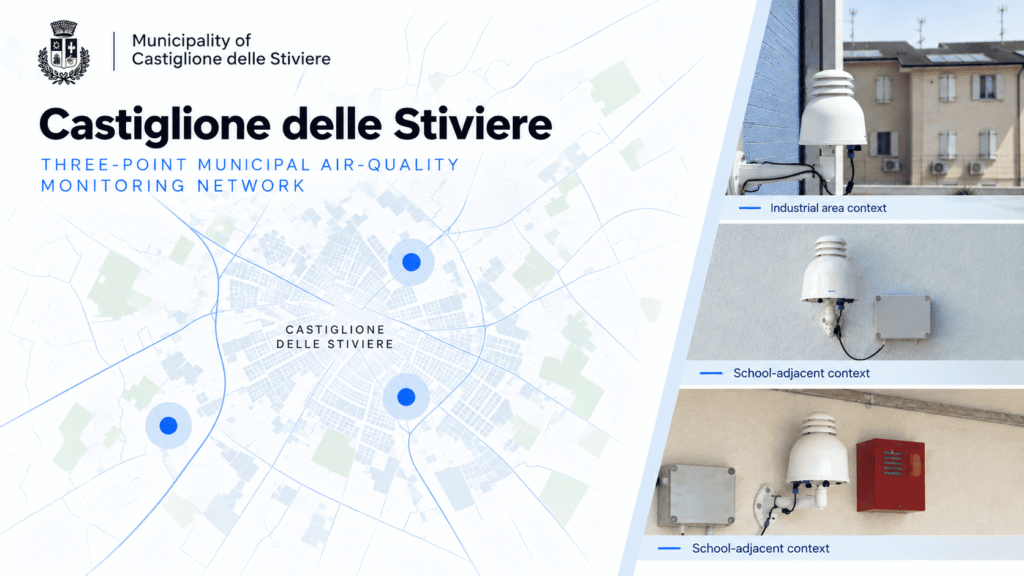
With several monitoring points, the same approach can add spatial context: teams can compare how measured noise conditions evolve at different boundaries, receptors or urban locations without assuming that a difference between points automatically identifies its cause.
Aernode Cloud provides the common environment for supervising distributed monitoring points and reviewing current and historical data, while Reporting Tools can support visualization, threshold-based operational notifications and reporting workflows. Notifications should be treated as triggers for review rather than formal acoustic or regulatory determinations.
Noise data can also be reviewed alongside traffic, site activity, meteorology and other environmental measurements available in the wider monitoring programme. This multiparametric context can help teams understand what was happening when a noise event occurred and decide whether targeted investigation is warranted, while co-occurrence alone does not establish source attribution or causality.
When Aernode noise monitoring is the right operational tool
Aernode noise monitoring is particularly useful for persistent observation of noise-level patterns, unusual events, recurring conditions, operational changes and differences between selected monitoring locations. Its value increases when siting, data continuity and project context are controlled for the intended comparison.
Where a project requires prescribed acoustic descriptors, formal compliance assessment, detailed acoustic characterisation, source analysis or strategic modelling, a specialist assessment is more appropriate. The key is to use Aernode noise monitoring for the evidence role it performs well: persistent visibility, event review and targeted operational follow-up.
Technical references
- IEC 61672-1:2013 – Electroacoustics – Sound level meters – Part 1: Specifications
- ISO 1996-1:2016 – Acoustics – Description, measurement and assessment of environmental noise – Part 1: Basic quantities and assessment procedures
- ISO 1996-2:2017 – Acoustics – Description, measurement and assessment of environmental noise – Part 2: Determination of sound pressure levels
- Directive 2002/49/EC – Assessment and management of environmental noise
- European Commission – Environmental Noise Directive