Why landfill odour events are difficult to reconstruct
By the time a landfill odour complaint is reviewed, the conditions that produced it may already have changed. Odour events can be intermittent and local: wind can shift, an operating activity can end, and the mixture of compounds reaching a boundary or receptor can change within minutes. A measurement at only one point is rarely sufficient to reconstruct that sequence. The practical monitoring problem is therefore not simply detecting a gas concentration, but preserving enough time-synchronised evidence to understand what was happening before, during and after the event.
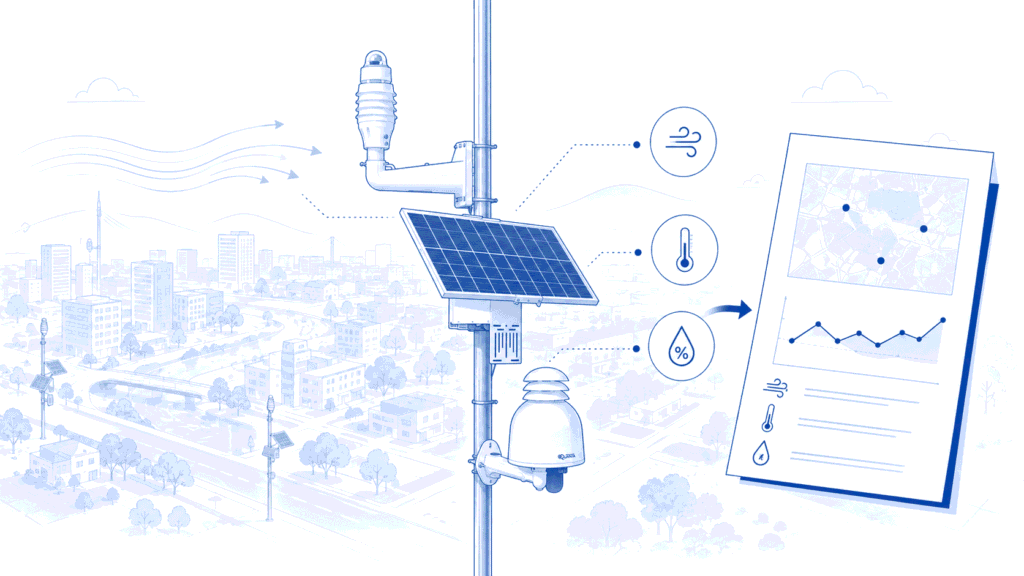
Continuous perimeter monitoring can help by recording selected chemical indicators, meteorology and differences between locations, then aligning those data with complaint and site-operation records. Used this way, the network becomes evidence infrastructure for investigation. It does not directly measure human odour perception, replace field inspection or dynamic olfactometry, or prove which source caused an odour.
This guide focuses on ambient monitoring around operational areas, site boundaries and relevant receptors. It excludes source-emission olfactometry, formal landfill-gas migration or borehole monitoring, occupational exposure monitoring and automatic source attribution.
Different monitoring methods answer different questions
Landfill odour assessment involves distinct measurement questions. Sensory or field assessment addresses human perception at a defined place and time. Dynamic olfactometry measures odour concentration from a collected source sample under a standardized laboratory method. Continuous chemical and environmental monitoring records selected indicators and context over time. These approaches can complement one another, but they are not interchangeable.
European standards make the distinction clear. EN 13725:2022 covers dynamic olfactometry and odour emission rate; EN 16841-1 and EN 16841-2 cover field inspection methods for ambient odour. A continuous perimeter network answers a different question: did selected environmental signals change at particular times and locations, and what meteorological and operational conditions coincided with those changes?
| Monitoring question | Useful evidence layer | What it can establish |
|---|---|---|
| Was an odour perceived in ambient air? | Structured field inspection / sensory assessment | Human perception at defined times and locations, using the applicable method. |
| What is the odour concentration or emission rate from a defined source? | Dynamic olfactometry where applicable | A standardized source-related odour measurement under the method’s defined conditions. |
| Did selected ambient indicators and site conditions change around an event? | Continuous perimeter gas/PM monitoring + meteorology + operational/event records | Time-resolved context for investigation and comparison across locations; not direct odour measurement or proof of source. |
For European landfill operations, Directive 1999/31/EC on the landfill of waste, as amended, provides the relevant baseline: measures are required to minimise nuisances and hazards from landfill, including emissions of odours and dust. It does not prescribe a universal perimeter sensor network, H2S requirement, node count or odour threshold. National rules, permits and project specifications remain site-specific.
Why one gas cannot represent landfill odour
Landfill odour is not a single-channel measurement problem. Waste streams and processes can produce different compounds and mixtures, and their importance can change over time and across a site. A recent peer-reviewed review of landfill odour assessment highlights this diversity and the move toward more spatial and time-resolved monitoring approaches.
Hydrogen sulfide (H2S) is a useful example. It can be a valuable site-specific indicator where sulfur-related anaerobic processes are relevant, but it is not a universal proxy for landfill odour. Low H2S does not prove that no odour was present; elevated H2S does not establish that a landfill source caused a reported event.
Broad VOC indicators or PID responses have the same boundary. They can show that volatile conditions changed and support comparisons between locations or events, but an indicator is not automatically an odour surrogate: these responses do not directly determine human odour perception or identify individual compounds in a mixture. Select indicators that test plausible site-specific hypotheses rather than searching for one sensor that represents all odour.
Build the network around the source–pathway–receptor question
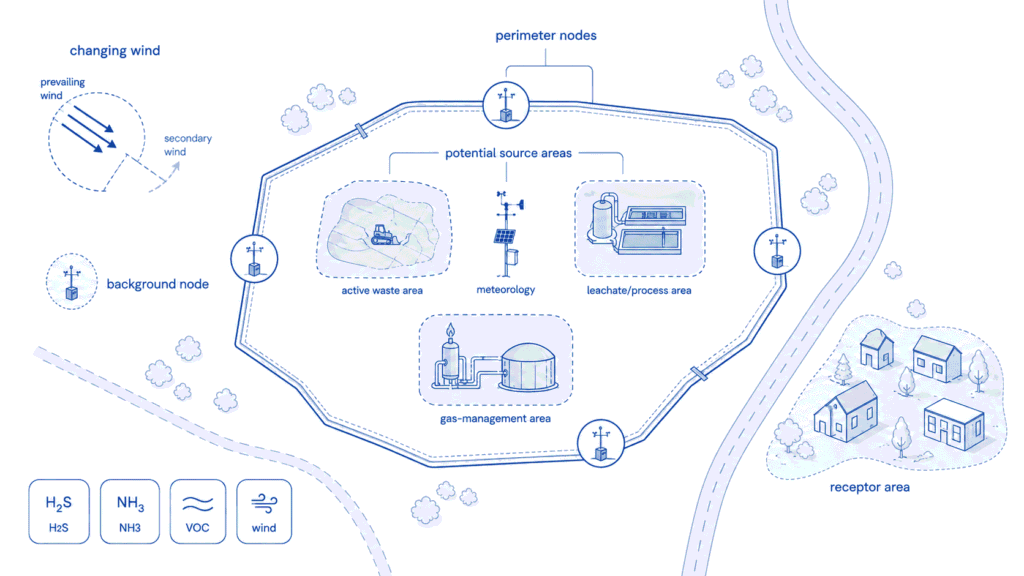
If the purpose of continuous monitoring is to reconstruct an event, the network must preserve spatial evidence. Start with the source–pathway–receptor question: what potential source areas exist, how could emissions travel under changing atmospheric conditions, and which boundary locations or receptors matter to the investigation?
Potential source areas depend on the site and operating phase; examples can include active waste placement, transfer, leachate handling, biological treatment or gas-management infrastructure. The pathway changes with wind and local dispersion. The network should preserve comparisons between these areas, perimeter locations and relevant receptors rather than treat one station as representative of the whole site.
Use positions that allow comparison
There is no universal node count or spacing. A practical layout may combine:
- operational or source-adjacent locations where safe access and the investigation question justify them;
- boundary locations that can become downwind under important wind sectors;
- an upwind or background location where a representative comparison is feasible;
- locations relevant to a recurring complaint or receptor question;
- a representative, unobstructed meteorological measurement position.
“Upwind” and “downwind” are changing roles, not permanent node identities. A location that is upwind during one event may be downwind during another. The design should make those changes useful for comparison.
The 2024 IMPEL landfill inspection guidance similarly places air-quality monitoring and meteorological context within a landfill self-monitoring framework. Its example uses measurement points along the main wind direction together with meteoclimatic information, reinforcing the practical value of designing spatial comparison and wind context together; it is not a universal prescription for node count or fixed upwind/downwind roles.
Treat meteorology as part of the measurement architecture
Wind direction and speed provide the pathway context for simultaneous changes across the network, so they should be time-synchronised with air-quality data. Low wind speeds, variable flow, terrain and structures can complicate interpretation. Meteorology helps narrow the investigation; it does not prove origin by itself.
Choose parameters from the site, not from a fixed sensor package
There is no universal landfill odour sensor package. The useful configuration depends on waste streams, processes, expected source areas and the decisions the data need to support. “Multi-parameter” should mean the smallest useful set of measurements that can test the site-specific working hypotheses, not every available sensor.
| Parameter / context | What it may support | Important limitation |
|---|---|---|
| H2S | Investigation of sulfur-related gas events where H2S is a plausible site indicator. | Not a universal proxy for landfill odour; response and usefulness are site- and sensor-specific. |
| NH3 | Context for nitrogen-rich or biological waste processes where ammonia is a plausible indicator. | Not relevant to every landfill or every odour event; cannot represent total odour. |
| VOC indicator / PID response | Detection of changes in broad volatile conditions and comparison between locations. | Does not identify individual compounds or directly determine odour concentration. |
| PM10 / PM2.5 | Operational context for dust from traffic, handling or surface activities. | Particulate matter is an air-quality parameter, not an odour measure. |
| Wind speed / direction | Pathway context for comparing simultaneous measurements across nodes. | Needs representative siting and time synchronisation; direction alone is not proof of origin. |
| Temperature / relative humidity | Environmental context and support for sensor-quality interpretation. | Environmental effects can influence sensor response and should be considered in QA. |
A site with a recurring sulfur-related pattern may justify a different configuration from one where complaints appear associated with mixed volatile emissions or biological treatment. Review the parameter set as operations change. More channels are useful only when they add independent information.
Turn continuous data into an odour-event investigation
The practical payoff appears when continuous measurements feed a repeatable investigation workflow. Guidance for permitted sites in England provides a useful transferable principle: complaint investigation should clarify what was happening on site at the relevant time, rather than use one monitoring result simply to validate or dismiss the report. European projects must still follow their own permit and jurisdictional requirements.
IMPEL’s 2024 guidance complements that investigation logic at a broader European landfill-management level: it recommends mapping odour emissions, auditing potential sources, registering complaints, applying site-specific measures and following up both measures and complaints.
A disciplined sequence is:
- Record the event or complaint with time, location and a concise description, separate from any assumption about source.
- Check meteorology at the relevant time, including wind direction, wind speed and conditions that may complicate dispersion.
- Compare multiple monitoring nodes. Look for timing, gradients and whether the spatial pattern changes with the wind sector.
- Compare the relevant parameters. A multi-parameter pattern may support a different hypothesis from an isolated change in one channel.
- Compare the monitoring record with site operations: waste delivery, placement, turning, leachate activities, maintenance, gas-system changes or other relevant logged activities.
- Decide whether the evidence supports an operational check or targeted follow-up, such as field inspection, source-specific sampling, olfactometry or another permit/site method.
- Document the interpretation, any action taken and the subsequent data or field observation used for verification.
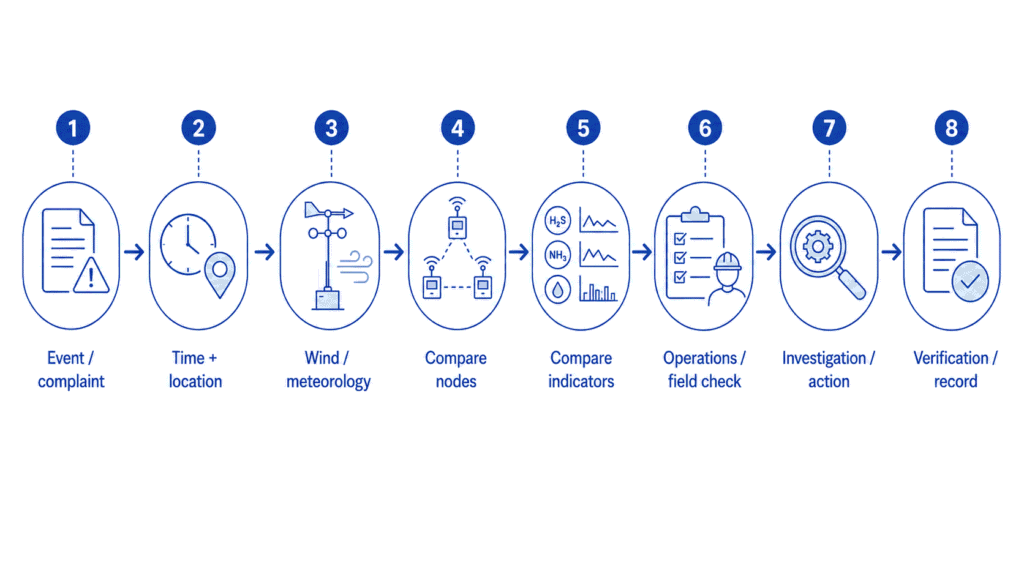
One sensor trace is an observation. Aligned evidence from location, meteorology, selected indicators and operations can support a stronger working hypothesis and more targeted follow-up. Source attribution still requires evidence appropriate to the claim.
Use alerts as investigation triggers, not as universal odour thresholds
Continuous data can support automated notifications, but alert logic should be project-specific. A universal H2S concentration for all landfill odour events would not be technically defensible. Depending on the site, useful triggers may use local baseline behaviour, rate of change, spatial differences or multi-parameter patterns.
Where a permit, authority or project specification defines a formal limit, handle it separately and exactly as written. An operational alert can trigger review of the evidence chain; it is not automatically a regulatory exceedance.
Protect the investigation with data-quality safeguards
Event reconstruction is only as credible as the record behind it. If instrument state, data completeness or environmental conditions cannot be reconstructed, the event cannot be interpreted confidently. Define focused controls before complaints occur:
- baseline behaviour across wind sectors, seasons and normal operating states;
- measurement range, LOD or lowest operational concentration, cross-sensitivities and environmental response of each selected sensor;
- calibration, field checks, maintenance and replacement appropriate to the sensing technology;
- time synchronisation across air-quality, meteorological and operational data;
- data completeness and flags for downtime, servicing or suspect periods;
- representativeness of the meteorological sensor location;
- consistent complaint and operational-event logs so later comparisons remain auditable.
These controls preserve the context needed to decide whether a pattern is meaningful, whether events can be compared and whether a follow-up conclusion is supportable.
Where Aernode fits in a landfill perimeter monitoring workflow
For Landfills & Waste Treatment, Aernode can provide a distributed continuous supplementary environmental monitoring layer around this investigation framework. The Aernode Air Quality Monitor provides the field platform, while Sensor Kits support project-specific gas configurations where the selected indicators are appropriate. Meteorological measurements can be included where required by the design.
Aernode Reporting Tools can support real-time and historical review, operational alerts and reporting across locations and time. The value is preserving and reviewing the evidence chain, not converting a chemical sensor into a direct odour measurement.
This role remains bounded: perimeter monitoring does not replace direct odour assessment, formal landfill-gas monitoring, occupational exposure monitoring or a permit method required by the applicable authority, and it does not provide automatic source attribution.
Build the investigation around multiple lines of evidence
The strongest continuous landfill odour programme is not the one with the most sensors, the lowest threshold or the largest parameter list. It is the one that preserves enough complementary, time-synchronised evidence to reconstruct conditions around an event and decide what investigation or action is justified.
Design for:
- a precise time and location record for the event or complaint;
- spatial comparison as monitoring-point wind roles change;
- the smallest useful set of site-specific indicators;
- operational records aligned with the monitoring data;
- documented follow-up and verification.
A single sensor can show that something changed. A well-designed evidence chain shows what else changed at the same time, where it changed and what should be checked next. That is the practical role of continuous perimeter monitoring in landfill odour investigation.
Technical References
1. Directive 1999/31/EC on the landfill of waste, as amended — consolidated EUR-Lex text — EU legal baseline for landfill operations, including nuisance and hazard minimisation.
2. EN 13725:2022 — Stationary source emissions. Determination of odour concentration by dynamic olfactometry and odour emission rate — European standard context for source-related odour measurement.
3. EN 16841-1:2016 — Ambient air: Determination of odour in ambient air by using field inspection — Grid method — European standard for field inspection of ambient odour exposure.
4. EN 16841-2:2016 — Ambient air: Determination of odour in ambient air by using field inspection — Plume method — European standard for plume field inspection.
5. Hassan, S. Z. et al. (2025), “A review of landfill odors assessment: Advancing from stationary measurement to spatiotemporal monitoring,” Waste Management — Peer-reviewed review of landfill odorants and monitoring approaches.
6. Environment Agency (2025), “Odour management: comply with your environmental permit — writing an odour management plan” — Guidance for permitted sites in England, used here for transferable complaint-investigation, record-keeping and monitoring principles.
7. IMPEL (2024/2025), “Inspection Guidance Book for Landfill Inspection — Revision 2024”, European Union Network for the Implementation and Enforcement of Environmental Law — European regulator-network guidance used for landfill self-monitoring, air-quality / meteorological context and odour-management good-practice principles.