Indicative monitoring is a measurement role, not an instrument type
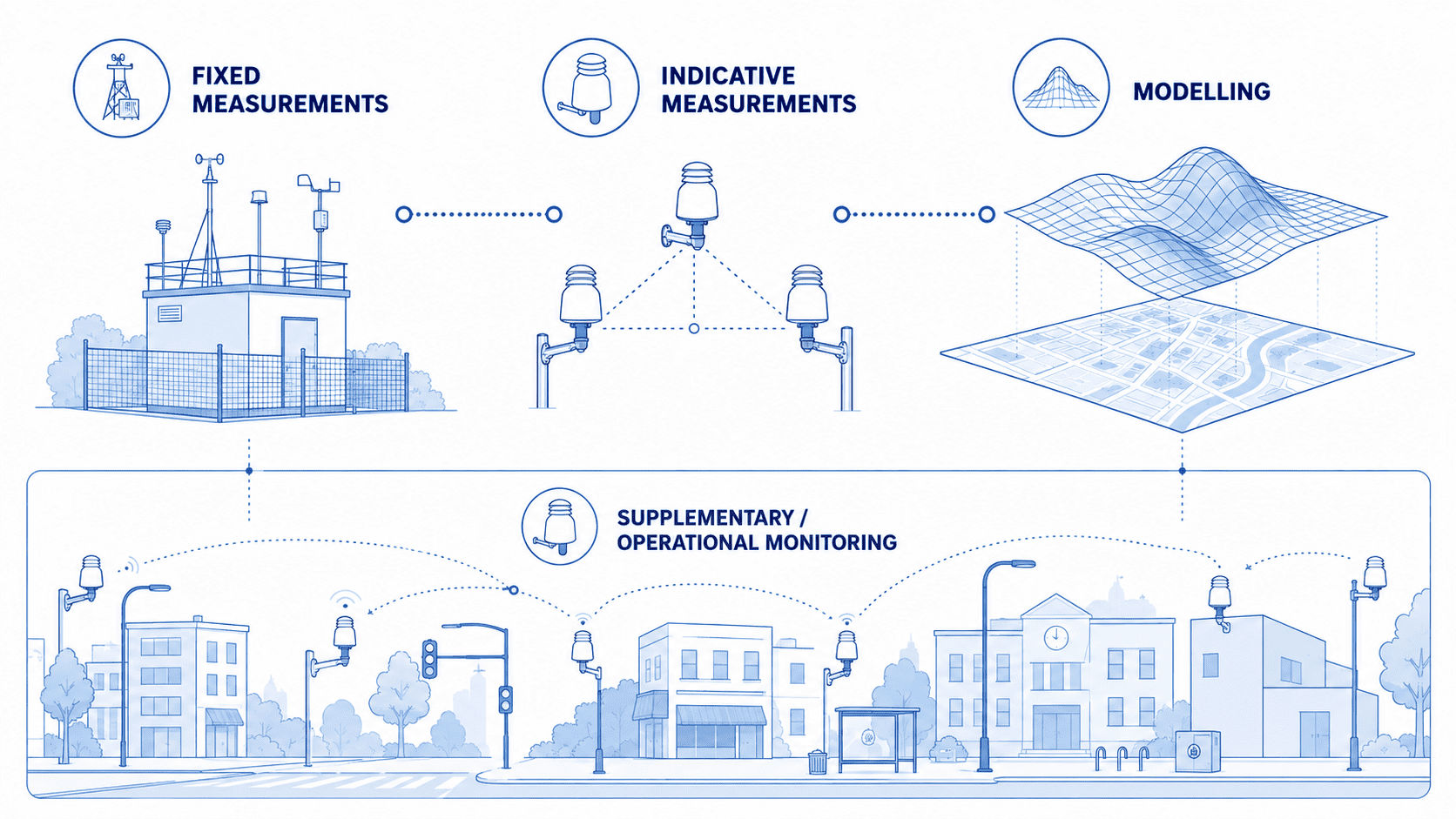
The current Directive (EU) 2024/2881 defines fixed measurements and indicative measurements as different assessment categories. Fixed measurements are taken at constant locations and must meet the relevant fixed-measurement data-quality objectives. Indicative measurements are taken regularly during the year, or by random sampling, and must meet the Directive’s indicative-measurement data-quality objectives, which are less strict but still defined.
This is not a new idea created by recent sensor networks. Directive 2008/50/EC already defined indicative measurements as measurements meeting data-quality objectives less strict than those for fixed measurements. The 2024 recast changes and expands the assessment framework, but the underlying distinction has existed for years.
The practical consequence is important: “indicative” describes the quality and evidence role of a measurement programme, not the sensing principle inside the enclosure. An optical particle counter, an electrochemical gas sensor or another compact measurement system may form part of an indicative programme, but hardware alone does not establish the programme’s assessment role.
| TERM | WHAT IT MEANS | COMMON MISUNDERSTANDING TO AVOID |
|---|---|---|
| Reference method | A prescribed measurement method in the Directive’s technical framework. An alternative method may be used where equivalence is demonstrated under the applicable rules. | “Reference method” is not the same concept as “fixed measurement”. |
| Fixed measurement | A measurement category using constant sampling locations and the fixed-measurement DQOs. | A fixed station is not defined by enclosure size or purchase price. |
| Indicative measurement | A measurement category using less-strict but defined DQOs. | It is not any measurement from a compact or lower-cost sensor. |
| Supplementary / operational monitoring | A project-use description for additional monitoring used for screening, event review, local comparison, process context or other fit-for-purpose decisions. | It may be technically strong, but it is not automatically used as an indicative measurement within the EU ambient-air assessment framework. |
Why a sensor is not automatically an indicative measurement
European technical specifications make the same distinction at device level. CEN/TS 17660-1 for gaseous sensor systems and CEN/TS 17660-2 for particulate-matter sensor systems describe performance-classification procedures under prescribed test conditions. Their scope is tied to the 2008 Directive’s indicative and objective-estimation categories, and Part 2 explicitly warns that passing prescribed tests does not guarantee the same performance in different locations, meteorological conditions or over time without ongoing quality control. The CEN/TS 17660 classifications apply to individual sensor systems. They do not by themselves qualify an entire deployed sensor network or monitoring programme, although the specifications include guidance on the use of sensor systems as nodes within networks.
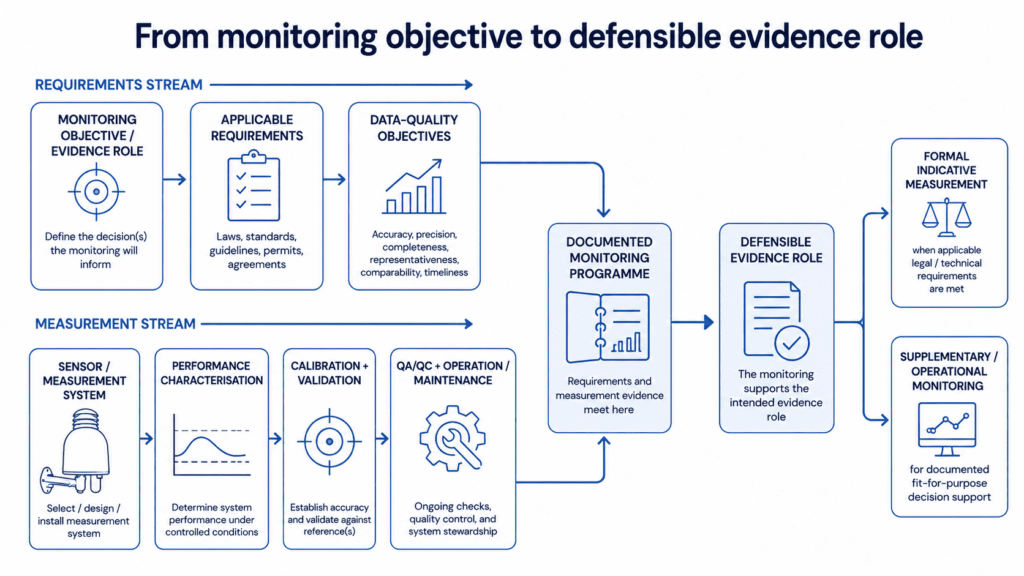
That leads to a useful hierarchy. The sensor or instrument has a performance envelope. The installed system has a field response that can be affected by environment, ageing, inlet design, data processing and maintenance. The monitoring programme then adds site selection, calibration, quality assurance, data coverage, data review and an intended evidence role. “Indicative measurement” becomes defensible only when the relevant level of that hierarchy has been demonstrated for the use being claimed.
Where indicative measurements fit in the EU ambient-air framework
The EU framework does not create one universal hierarchy in which fixed measurements are “real data” and indicative measurements are merely informal. It assigns different methods different roles depending on pollutant levels, the purpose of the assessment and the available evidence.
- Above assessment thresholds, fixed measurements remain the backbone. Directive (EU) 2024/2881 requires fixed measurements for ambient-air assessment in those zones. They may be supplemented by modelling or indicative measurements to provide spatial-distribution and spatial-representativeness information.
- In exceedance zones, complementary evidence becomes more systematic. After the relevant implementation period, modelling applications or indicative measurements are to be used in addition to fixed measurements where relevant limit or target values are exceeded.
- Below assessment thresholds, other assessment methods can be sufficient. The recast allows modelling, indicative measurements, objective estimation or combinations of these methods to be sufficient in zones classified below the assessment thresholds.
- Indicative results can have a formal assessment role. Where the Directive uses indicative measurements for assessment, their results are not merely informational: the framework specifies when they are to be taken into account.
Timing matters in 2026. Member States must transpose the main relevant provisions of the recast by 11 December 2026, and Directives 2008/50/EC and 2004/107/EC are repealed from 12 December 2026. The adopted Commission Implementing Decision (EU) 2026/1208 adds technical rules for modelling and spatial representativeness and applies from 30 June 2028. A live project should therefore be checked against the rules actually applicable in the relevant Member State and at the time the monitoring programme is designed.
What the data-quality objectives actually change
Calling a dataset “indicative” is meaningful only if the applicable data-quality objectives are understood. Annex V of Directive (EU) 2024/2881 sets pollutant- and averaging-period-specific requirements for measurement uncertainty and minimum data coverage. The indicative limits are less strict than those for fixed measurements, but they are still quantitative requirements rather than a vague “medium accuracy” label.
Maximum uncertainty for indicative measurements under Annex V
Annex V of Directive (EU) 2024/2881 defines maximum measurement uncertainty for indicative measurements by pollutant and averaging period. The uncertainty is expressed at a 95% confidence level. The tables below summarise every pollutant and time basis for which Annex V Tables 1 and 2 specify an indicative-measurement uncertainty. These are legal data-quality-objective values: they are not Aernode performance specifications, sensor specifications, proof that a particular Aernode configuration meets these values, or universal quality targets for every supplementary monitoring project.
Long-term / annual indicative measurements
| Pollutant | Period | Max absolute uncertainty | Max relative uncertainty |
|---|---|---|---|
| PM₂.₅ | Annual mean | 4.0 µg/m³ | 40% |
| PM₁₀ | Annual mean | 6.0 µg/m³ | 30% |
| SO₂ / NO₂ / NOx | Annual mean | 8.0 µg/m³ | 40% |
| Benzene | Annual mean | 1.2 µg/m³ | 35% |
| Lead | Annual mean | 0.175 µg/m³ | 35% |
| Arsenic | Annual mean | 3.0 ng/m³ | 50% |
| Cadmium | Annual mean | 2.5 ng/m³ | 50% |
| Nickel | Annual mean | 10.0 ng/m³ | 50% |
| Benzo(a)pyrene | Annual mean | 0.6 ng/m³ | 60% |
Short-term indicative measurements
| Pollutant | Period | Max absolute uncertainty | Max relative uncertainty |
|---|---|---|---|
| PM₂.₅ | 24-hour mean | 8.8 µg/m³ | 35% |
| PM₁₀ | 24-hour mean | 22.5 µg/m³ | 50% |
| NO₂ | 24-hour mean | 12.5 µg/m³ | 25% |
| NO₂ | Hourly mean | 50 µg/m³ | 25% |
| SO₂ | 24-hour mean | 12.5 µg/m³ | 25% |
| SO₂ | Hourly mean | 87.5 µg/m³ | 25% |
| CO | 24-hour mean | 1.0 mg/m³ | 25% |
| CO | 8-hour mean | 2.0 mg/m³ | 20% |
| Ozone | 8-hour mean | 30 µg/m³ | 25% |
Before 2030, the relative maximum-uncertainty values in Annex V Tables 1 and 2 apply to indicative measurements. The special pre-2030 exceptions stated in Annex V for annual PM₂.₅ and NO₂/NOx apply to fixed measurements, not to the indicative-measurement values listed above. From 2030, the uncertainty of measurement data used for ambient-air-quality assessment must not exceed the absolute or relative value specified in Annex V, whichever is higher.
The Annex V uncertainty is the uncertainty of the assessment method expressed at a 95% confidence level. It is a property of the complete measurement approach used for the assessment, not simply the nominal resolution or manufacturer accuracy specification of a sensor. The Directive also specifies that the uncertainty is to be interpreted as applicable in the region of the relevant limit value or target value.
The percentages in Annex V Tables 1 and 2 apply to limit values and target values calculated by simple averaging of individual measurements, including hourly, daily and annual means. The uncertainty calculation described there is not directly applicable to AOT40; values combining more than one year; values combining more than one sampling point, such as AEI; values combining more than one component; alert thresholds; information thresholds; or critical levels for the protection of vegetation and natural ecosystems.
Annex V also provides that where indicative measurements are used for purposes other than compliance assessment—for example monitoring-network design or review, or calibration / validation of modelling applications—the applicable uncertainty may instead be that established for modelling applications.
The same Annex sets minimum data coverage. For several major pollutants, annual-mean indicative assessment has a 13% minimum data-coverage requirement, while short-term 1-hour, 8-hour or 24-hour indicative assessment uses 50% in the listed cases. Those figures do not mean that collecting only the minimum is automatically good project practice. Measurements must also be distributed in a way that avoids seasonal or temporal bias, and the project must satisfy the full conditions that apply to the pollutant and assessment purpose.
For professional monitoring design, the broader lesson is more useful than any one percentage: data quality has several dimensions. Uncertainty, valid-data coverage, temporal distribution, calibration, traceability and ongoing QA/QC all matter. A continuous high-frequency time series can be operationally valuable while still failing a formal DQO if its uncertainty or quality-control evidence is inadequate. Conversely, a lower-coverage programme can have a formal role when it is designed and evaluated within the relevant rules.
What indicative air quality monitoring is not
- It is not automatic reference equivalence. Indicative measurements have different data-quality objectives and roles from fixed measurements; where an equivalent method is claimed, equivalence has to be demonstrated under the applicable technical framework.
- It is not any connected sensor network. A device that streams near-real-time values does not become an indicative measurement simply because it is compact, continuous or described that way commercially.
- It is not a compliance badge attached to hardware. Formal use depends on the measurement method, programme, data quality, applicable legal framework and competent-authority requirements—not on a product label alone.
- It is not immune to environmental effects or drift. Sensor response can change with temperature, humidity, interfering gases, aerosol properties, ageing, contamination and other application-specific factors. Characterisation and QA/QC remain necessary.
- It is not automatic source attribution. A change in concentration can support investigation, but a time-series peak or spatial gradient does not by itself prove which source caused it. Meteorology, site activity, other measurements and stronger evidence may be needed.
Indicative measurements and supplementary monitoring serve different evidence roles
Many useful air-quality monitoring programmes are designed to answer local or operational questions rather than to perform a statutory ambient-air assessment. Construction projects, industrial sites, research campaigns and municipal networks may use continuous sensor-based measurements to investigate spatial differences, recurring episodes, operational conditions or changes over time.
These applications can produce valuable environmental evidence without the measurements being used as indicative measurements within the EU ambient-air assessment framework. The distinction is one of evidence role and intended use: indicative measurements operate within a defined assessment framework and its applicable data-quality and methodological requirements, while supplementary monitoring is designed around the specific decisions and quality objectives of the project.
| DIMENSION | INDICATIVE MEASUREMENT — EU ASSESSMENT ROLE | SUPPLEMENTARY / OPERATIONAL MONITORING |
|---|---|---|
| Primary purpose | Ambient-air assessment within the applicable legal framework. | Project-specific decision support: screening, event investigation, spatial comparison, operational oversight, research or reporting context. |
| Quality target | Applicable regulatory DQOs and method requirements. | Project-defined fit-for-purpose requirements; may reference regulatory DQOs where appropriate, but the project purpose remains explicit. |
| Governance | Competent-authority framework, documented methods and applicable assessment rules. | Project owner / consultant / research protocol with documented calibration, QA/QC and interpretation rules. |
| What the data can support | Assessment roles defined by the applicable framework when the legal and technical conditions are met. | Operational decisions and investigation within the stated uncertainty and limitations. |
| What cannot be assumed | That any sensor system automatically qualifies. | That operational usefulness confers formal compliance status. |
The categories can overlap in practice: the same platform could be used in different programmes, and a supplementary project may intentionally design its performance around indicative-measurement DQOs. What must remain clear is which role is actually being claimed for the data.
What can a municipality use supplementary air-quality monitoring for?
For a municipality, the distinction between supplementary and formal assessment data is not the distinction between “useful” and “useless” measurements. It is a distinction between evidence roles. A supplementary network should not by itself be presented as the official determination of a statutory ambient-air limit-value exceedance, as formal proof of regulatory non-compliance, or as a substitute for the competent-authority assessment process. The same network can nevertheless provide valuable additional evidence for local decisions. Supplementary monitoring adds resolution and decision-support evidence without replacing the official assessment framework.
Official monitoring networks are designed around statutory assessment requirements. Municipalities may also need greater spatial density, temporary deployments, street or neighbourhood comparisons, measurements near schools or other sensitive locations, traffic-corridor investigation, industrial or mixed-use boundaries, project-specific campaigns and before/after monitoring. The official network is not deficient; the two layers answer partly different questions: the first provides statutory assessment, while supplementary monitoring can increase local spatial and temporal knowledge.
Not being the dataset used to make a statutory compliance determination does not make supplementary monitoring secondary in practical value. A quality-managed network can compare areas, screen for recurring local hotspots, identify timing and recurrence, and highlight patterns that deserve investigation. Hotspot screening is not source attribution: a concentration gradient or recurring peak can support investigation, but it does not by itself establish causality. The same evidence can inform transport or urban-planning priorities and establish a local baseline for before/after evaluation, provided comparability, meteorology, time period and data quality are considered.
| PUBLIC-ADMINISTRATION USE | SUPPLEMENTARY MONITORING | INDICATIVE MEASUREMENT — EU ASSESSMENT ROLE |
|---|---|---|
| Identify local spatial patterns / hotspots | YES — for local screening and investigation within the stated measurement uncertainty and network limitations. | YES — within its defined assessment role. |
| Compare locations or periods | YES — when measurements are sufficiently comparable and quality-managed. | YES — within the applicable method and DQO framework. |
| Support urban / transport planning | YES — as decision-support evidence. | YES — as evidence within its defined role. |
| Prioritise locations for further assessment | YES. | YES. |
| Evaluate before / after local interventions | YES — with appropriate controls for comparability, meteorology and data quality. | YES — subject to the same interpretation safeguards and applicable assessment requirements. |
| Investigate recurring episodes | YES — timing, recurrence, spatial comparison and context can support investigation. | YES. |
| Inform citizens / stakeholders | YES — if measurement role, quality and limitations are communicated clearly. | YES — according to the applicable assessment / information framework. |
| Declare an official statutory limit-value exceedance by itself | NO. | ONLY where the measurements are being used within the applicable formal assessment framework and according to the relevant legal / competent-authority requirements. |
| Automatically trigger statutory procedures associated with an official exceedance | NO — not by itself. | ONLY according to the applicable legal framework and competent-authority procedure. |
| Prove which source caused an event | NO — concentration measurements alone do not establish causality. | NO — use within an assessment role does not itself establish source causality. |
Traffic example. A municipality operates several supplementary nodes along urban traffic corridors. If one corridor repeatedly shows higher concentrations at particular times of day than comparable locations, the municipality can investigate traffic and meteorological conditions, prioritise transport-planning analysis, commission stronger assessment where warranted and evaluate later interventions. It should not simply state that a supplementary node exceeded a legal limit and therefore an official statutory exceedance has been determined.
Urban-planning example. If a network consistently shows poorer air-quality conditions in one area than in comparable locations, that pattern can be one input when prioritising traffic changes, public-space design or green-infrastructure studies. Monitoring can continue before and after implementation to assess whether the observed pattern changes. The measurements do not by themselves establish which intervention is optimal or prove the causal effectiveness of a specific measure.
Indicative measurement is not simply “better supplementary monitoring”. It is a different evidence role used within the applicable ambient-air assessment framework when the required methods, data-quality objectives, uncertainty, coverage, calibration / validation, QA/QC, governance and competent-authority conditions are satisfied. Supplementary monitoring is designed around project-specific decision support. These are different evidence functions, not a quality ranking.
Official ambient-air assessment remains governed by the competent-authority framework established in each Member State. Fixed measurements, indicative measurements, modelling and other assessment methods are used according to the roles and conditions defined by the applicable framework. A municipality operating a supplementary network should therefore distinguish its decision-support dataset from the measurements and methods used within statutory ambient-air assessment.
Whether the project is intended for formal assessment or municipal decision support, the evidence role should therefore be defined before the network is designed.
How to specify an indicative or supplementary monitoring project
A defensible project starts with the decision, not the instrument. A defensible monitoring programme should treat sensor selection, field performance assessment, calibration, QA/QC, recalibration, network operation and data management as connected parts of one measurement lifecycle. These principles are reflected in European Commission JRC guidance for air-quality sensor networks and are useful whether the project targets an indicative-measurement role within the applicable ambient-air assessment framework or a supplementary operational role.
- Define the evidence role. Is the dataset intended for formal ambient-air assessment, supplementary screening, operational investigation, research, trend analysis, modelling support or another use? Do not postpone this decision until after installation.
- Define the pollutant, averaging period and decision. A system suitable for one pollutant or time scale is not automatically suitable for another. Specify what concentration metric or pattern matters and what action could follow.
- Identify the applicable requirements. For formal use, check current EU, national and competent-authority rules. For supplementary work, document the contractual or project-specific quality targets and any regulatory DQOs being used as a reference point.
- Select and characterise the measurement system. Review measurement principle, expected concentration range, selectivity, environmental response, inlet/sampling design, field evidence, data-processing method and service life. Use performance-testing evidence where relevant rather than relying on nominal resolution alone.
- Design calibration, validation and QA/QC before deployment. Define reference comparisons or other calibration procedures, acceptance criteria, drift checks, invalid-data handling, maintenance and recalibration triggers. Keep raw and adjusted data relationships traceable where post-processing is used.
- Define interpretation and escalation rules. State what a high reading, spatial difference or alert should trigger. Screening data may justify investigation; decisions with larger legal, financial or health consequences may require stronger or independent evidence.
How to interpret indicative data without overclaiming it
The most useful interpretation combines the measurement with context and with the original monitoring objective. High-frequency data are particularly good at showing timing: when concentrations change, how long an episode lasts, whether a pattern repeats, and whether different locations behave differently. They can also support comparison with meteorology, site activity, traffic patterns, process logs or modelling outputs.
Absolute concentration values require more discipline. Before treating a difference as meaningful, check the measurement uncertainty, calibration state, environmental conditions, data completeness and whether the comparison is like-for-like. A small difference between two nodes may be smaller than the combined uncertainty. A large event can still require quality checks before it is interpreted as a real environmental change.
A practical decision sequence is: observe the signal; verify data quality and instrument status; add meteorological or operational context; compare other locations or independent evidence; investigate plausible explanations; and escalate to a stronger measurement or formal method where the consequence of the decision requires it. This preserves the operational speed of continuous monitoring without confusing early evidence with proof.
Where Aernode fits in indicative and supplementary monitoring
The Aernode Air Quality Monitor is designed for continuous supplementary air-quality monitoring. Where a project intends to use measurements as indicative measurements within the EU ambient-air assessment framework, whether a specific deployment can support that role must be established at programme and configuration level against the applicable method, data-quality objectives, calibration and validation evidence, QA/QC and competent-authority requirements. Its current data-quality architecture includes raw and adjusted datasets, centralized post-processing and project-specific calibration workflows. The hardware and data architecture do not by themselves assign an indicative-measurement role to a deployment.
The actual evidence role still depends on the pollutant, sensing configuration, measurement method, calibration evidence, validation evidence, field performance, local environment, averaging period, data coverage, uncertainty, QA/QC and applicable legal and competent-authority requirements. A product configuration should therefore not be labelled universally “indicative”. Where a project intends to use measurements within the EU ambient-air assessment framework, the applicable method, DQOs and competent-authority requirements have to be established for that specific use.
For particulate matter, the measurement principle also matters. The Aernode Guide on OPC vs gravimetric particulate matter measurement explains why optical and gravimetric methods can report the same PM fractions while answering different measurement questions. Applied examples of supplementary continuous monitoring are available for air quality monitoring for research and field studies and continuous air quality monitoring for industrial sites.
The useful question is not “Is this an indicative sensor?”
A better question is: what evidence role is the measurement intended to have, and what has to be demonstrated for that role? If the intended role is indicative measurement within the EU ambient-air assessment framework, the programme needs to be designed around the applicable data-quality objectives, methods, documentation and competent-authority requirements. If the answer is supplementary or operational monitoring, the project still needs fit-for-purpose quality targets, calibration, QA/QC and clear interpretation boundaries.
For a municipality, supplementary status does not make the data secondary in practical value. A well-designed network can add spatial and temporal evidence for investigation, planning, prioritisation and evaluation of local interventions, while official ambient-air assessment remains governed by the applicable competent-authority framework.
That distinction protects both credibility and usefulness. Indicative measurements and supplementary monitoring can both add valuable spatial and temporal evidence, but they do so within different evidence roles. The strongest projects make the intended decision, measurement uncertainty and interpretation limits explicit before the first data point is collected.